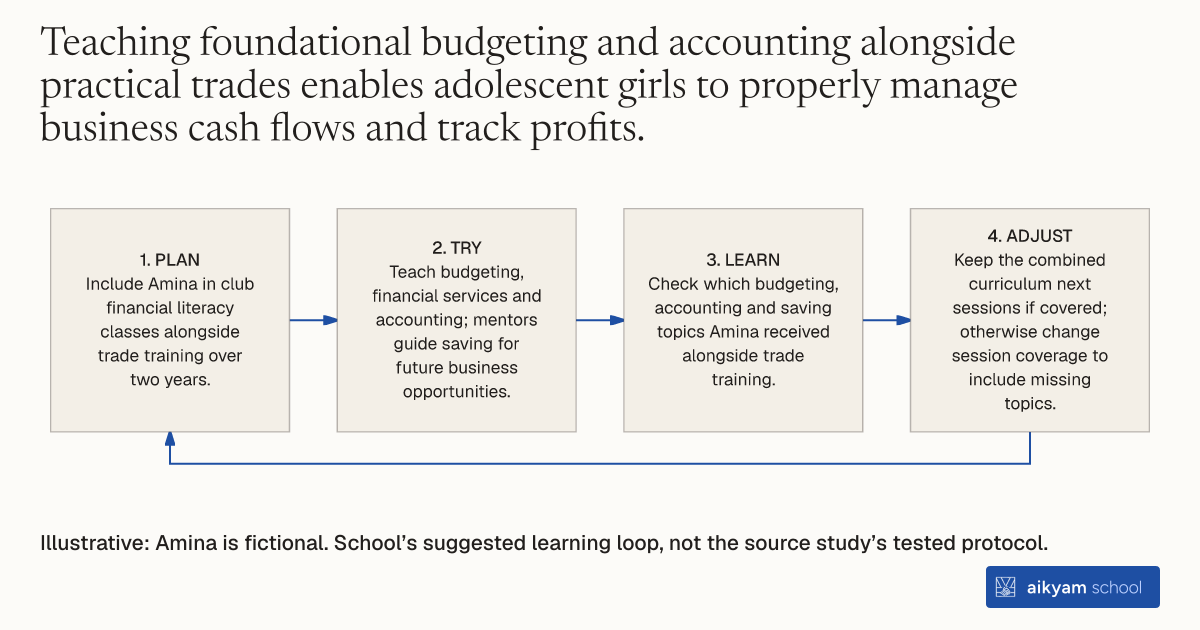
Try, learn and adjust
Check financial lessons accompany trade training
- Plan: Include Amina in club financial literacy classes alongside trade training over two years.
- Try: Teach budgeting, financial services and accounting; mentors guide saving for future business opportunities.
- Learn: Check which budgeting, accounting and saving topics Amina received alongside trade training.
- Adjust: Keep the combined curriculum next sessions if covered; otherwise change session coverage to include missing topics.
Illustrative: Amina is fictional. School’s suggested learning loop, not the source study’s tested protocol.
See source →School’s suggested, untested learning loop. Observe financial lesson coverage alongside trades. This suggested loop does not isolate effects of financial literacy from the wider programme.
How
When to use
Adolescent girls starting small enterprises face weak financial management knowledge and lack experience handling money. Standalone business training can fail if young entrepreneurs cannot track revenues or navigate financial services. Deliver targeted financial literacy instruction to equip youth with core budgeting and accounting skills needed for micro-enterprise operation.
Deliver practical financial literacy and accounting instruction alongside trade training in community youth clubs.
- Program instructors embed financial literacy classes within the adolescent development club curriculum over the two-year training period.
- Instructors teach core modules covering personal budgeting, financial service navigation, and basic accounting skills.
- Mentors and staff guide participants on saving techniques to accumulate capital for future business opportunities.
- Program staff offer course access to targeted club members, reaching thousands of adolescent girls across treated communities.
Why it works
Combining financial literacy with vocational skills relaxes both technical and financial management constraints at the same time.
Example
BRAC provided financial literacy courses to 2,500 club members across 100 treated communities in Uganda over two years. Combined with vocational courses, this training helped participating girls achieve an 8% increase in self-reported entrepreneurial ability at midline and a 50% increase in self-employment rates four years post-intervention.
About the study
Participants
4,888 adolescent girls tracked at midline and 3,522 at endline across 150 communities in Kampala, Mukono, Iganga, and Jinja, Uganda, with average baseline age of 16.3 years.
Study Design
Cluster randomized control trial across 150 communities (100 treatment, 50 control) stratified by 10 branch offices, evaluating outcomes at baseline, midline (2 years), and endline (4 years) using OLS ANCOVA and Lee bounds.
Results
Four years post-intervention, engagement in income-generating activities increased by 48%, self-employment rates rose by 50%, teen pregnancy fell by 34%, early marriage/cohabitation dropped by 62%, and reporting sex against will decreased by 31%.