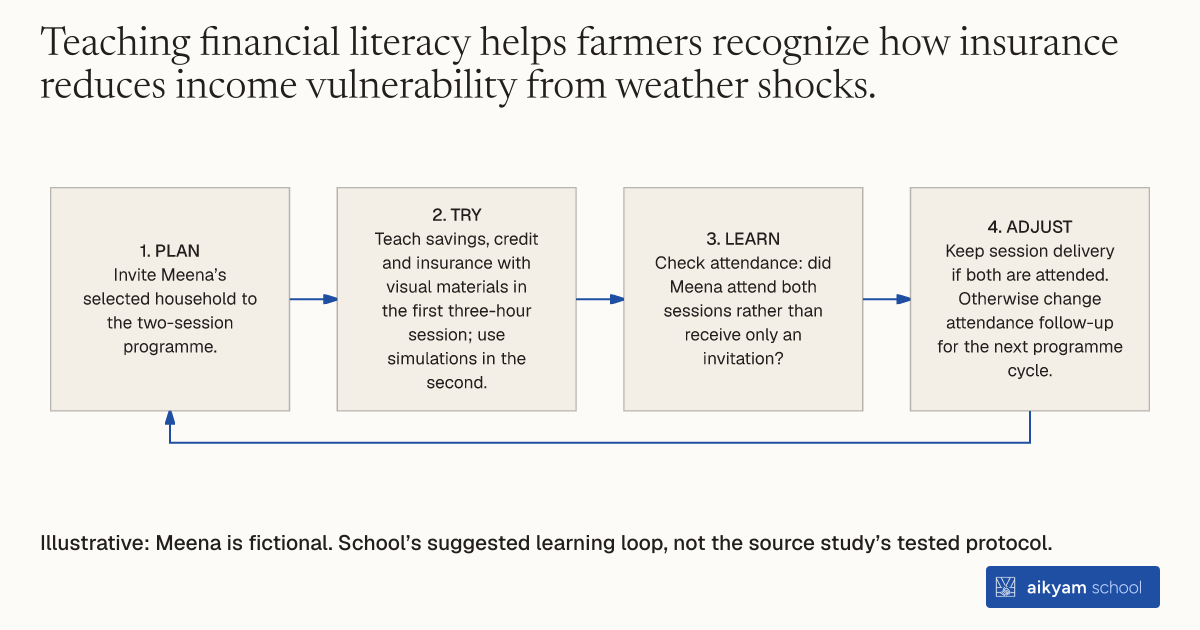
Try, learn and adjust
Check delivery of both financial education sessions
- Plan: Invite Meena’s selected household to the two-session programme.
- Try: Teach savings, credit and insurance with visual materials in the first three-hour session; use simulations in the second.
- Learn: Check attendance: did Meena attend both sessions rather than receive only an invitation?
- Adjust: Keep session delivery if both are attended. Otherwise change attendance follow-up for the next programme cycle.
Illustrative: Meena is fictional. School’s suggested learning loop, not the source study’s tested protocol.
See source →School’s suggested, untested learning loop. Observe invitations, session attendance and programme completion; an invitation is not completion.
How
When to use
Rural farming households often have a limited understanding of complex financial products like rainfall index insurance. This lack of knowledge keeps farmers from adopting protective financial tools against weather shocks. Delivering classroom educational sessions builds baseline financial literacy and explains the costs and benefits of insurance to smallholder farmers.
Deliver a structured two-session financial literacy program to rural farming households using trained NGO instructors.
- NGO trainers invite randomly selected farming households in target villages to attend a two-session financial literacy program.
- Instructors lead the first three-hour classroom session on basic financial management, covering savings, credit management, and insurance concepts.
- Facilitators use custom visual tools, including charts, posters, pamphlets, and a video emphasizing the importance of weather insurance.
- Trainers conduct a second session where farmers participate in practical simulation activities to observe how insurance operates.
Why it works
Increasing understanding removes confusion about costs and payouts, encouraging households to adopt complex financial products.
Example
Development Support Center and researchers invited three hundred landowning farmers in coastal Gujarat, India to a two-session program led by NGO trainers, increasing insurance adoption from 6.4 percent to 11.7 percent among invited households and reaching 14.5 percent among those who completed the training.
About the study
Participants
600 landowning farming households across 15 villages in Gujarat, India, with 300 randomly invited to the program and 75 percent attending.
Study Design
Randomized controlled trial comparing insurance take-up between households invited to two three-hour NGO-led sessions and a comparison group.
Results
An invitation increased rainfall insurance adoption by 5.3 percentage points above the 6.4 percent comparison base, while completing the program increased adoption by 8.1 percentage points at a cost of US\$62.82 per additional policy sold.