Try, learn and adjust
Check response to a retiree’s story
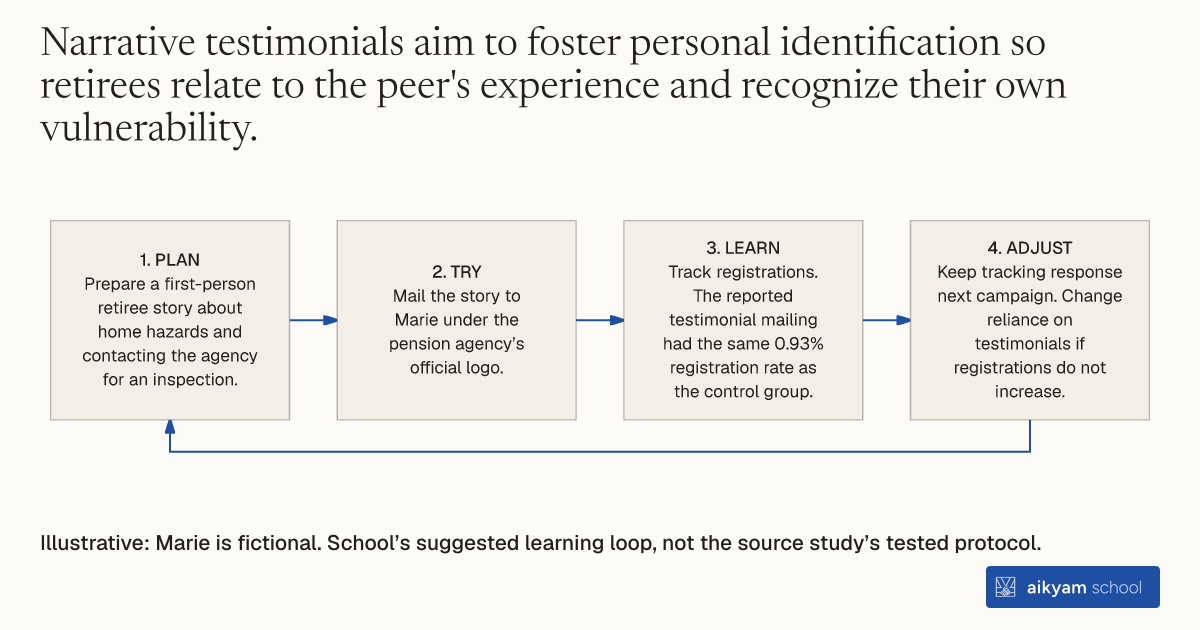
- Plan: Prepare a first-person retiree story about home hazards and contacting the agency for an inspection.
- Try: Mail the story to Marie under the pension agency’s official logo.
- Learn: Track registrations. The reported testimonial mailing had the same 0.93% registration rate as the control group.
- Adjust: Keep tracking response next campaign. Change reliance on testimonials if registrations do not increase.
Illustrative: Marie is fictional. School’s suggested learning loop, not the source study’s tested protocol.
See source →School’s suggested, untested loop. Observe registrations. The source reports no increase from the testimonial mailing.
How
When to use
Elderly retirees often overlook hazards in their living space and fail to seek preventive housing assessments. This method uses a relatable personal story from a fellow retiree to convey fall risks and motivate preventative home adaptations. It is designed for health promotion agencies seeking to engage older adults through narrative empathy rather than dry statistical tables.
Mail a personal first-person story of a peer retiree describing her experience with home fall risks and decision to participate in a housing adaptation program.
- Draft a first-person narrative written from the perspective of a retired woman sharing her personal reflections on home safety.
- Include the peer's personal account of recognizing hidden home hazards such as slippery floors or bath access obstacles.
- Detail in the narrative how the retiree contacted the social security agency to receive a personalized home safety inspection.
- Feature the agency's official pension logo on the mailing envelope and letterhead to ensure authenticity and trust.
- Mail the narrative brochure directly to target retired individuals across regional mailing waves.
Why it works
However, narrative framing can lack specific factual precision, making the perceived risk appear subjective or noisy.
Example
In Île-de-France, CNAV mailed Brochure 9 featuring a retired woman's testimonial to 3,006 retirees, resulting in a 0.93% program registration rate that was identical to the baseline control group.
About the study
Participants
48,090 retired individuals living in Île-de-France (Paris region), France; 3,006 received Brochure 9 with the testimonial story.
Study Design
Randomized controlled trial (field experiment) distributing narrative brochures and tracking PAP program registration over a 17-month period.
Results
The narrative testimonial produced no effect on program take-up, yielding a 0.00 percentage point change relative to the 0.93% baseline control group (FDR-adjusted p-value = 100.0%).