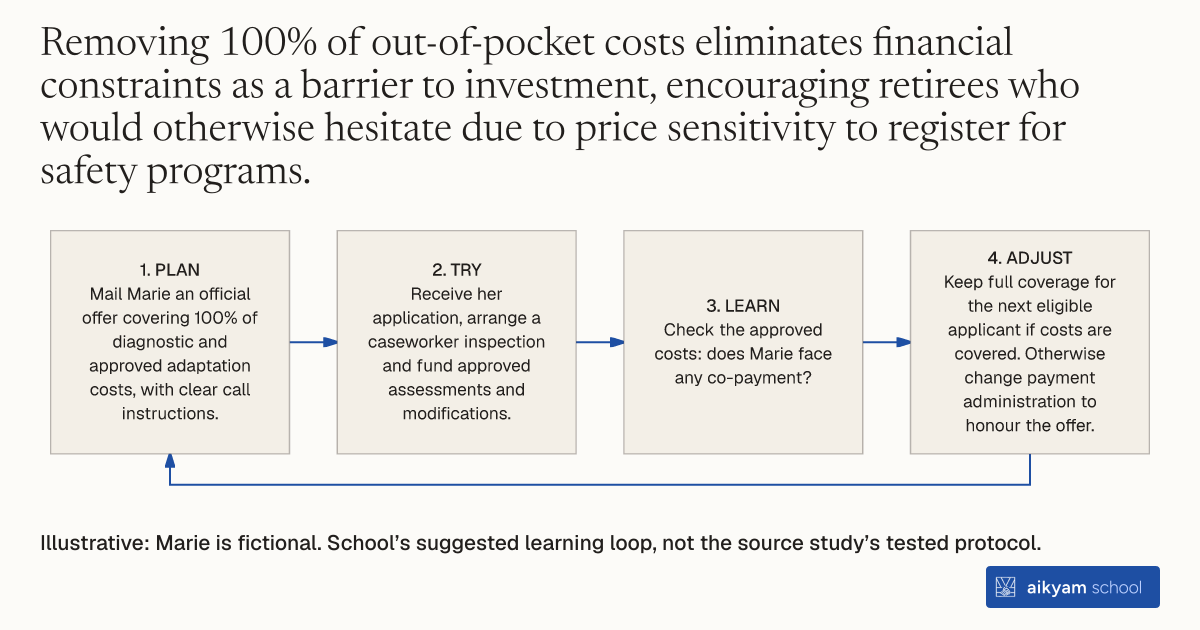
Try, learn and adjust
Check approved home adaptations have no co-payment
- Plan: Mail Marie an official offer covering 100% of diagnostic and approved adaptation costs, with clear call instructions.
- Try: Receive her application, arrange a caseworker inspection and fund approved assessments and modifications.
- Learn: Check the approved costs: does Marie face any co-payment?
- Adjust: Keep full coverage for the next eligible applicant if costs are covered. Otherwise change payment administration to honour the offer.
Illustrative: Marie is fictional. School’s suggested learning loop, not the source study’s tested protocol.
See source →School’s suggested, untested loop. Observe approved diagnostic and modification costs and any co-payment; do not infer fewer falls.
How
When to use
Elderly retirees frequently forgo housing safety improvements due to upfront financial costs and perceived out-of-pocket burdens. This method eliminates all direct financial barriers by fully covering the diagnostic and technical adaptation expenses for eligible seniors. It is designed for public pension agencies and social care providers seeking to evaluate the maximum impact of complete price subsidization on health investment take-up.
Fully finance all diagnostic and housing adaptation costs so that safety modifications are offered free of charge to retirees.
- Design outreach materials explicitly stating that home safety adaptations are completely subsidized with 100% of expenses paid.
- Mail the official notice containing clear call instructions to eligible retired individuals.
- Receive incoming applications from retirees through a designated social agency intake process.
- Dispatch a caseworker to conduct a home inspection and formulate a personalized adaptation plan.
- Cover 100% of the cost for approved diagnostic assessments and technical home modifications without requiring co-payments.
Example
In Île-de-France, CNAV mailed Brochure 5 informing 3,005 retirees that home adaptations were completely free, increasing program registration to 1.70% compared to 0.93% in the control group.
About the study
Participants
48,090 retired individuals living in Île-de-France (Paris region), France; 3,005 received Brochure 5 offering 100% subsidy.
Study Design
Randomized controlled trial (field experiment) comparing a 100% subsidy brochure against control groups and tracking PAP registration over 17 months.
Results
Offering a 100% subsidy significantly increased program registration by 0.77 percentage points (from 0.93% in the control group to 1.70%, an 83% relative increase), with the effect concentrated among higher-income retirees.