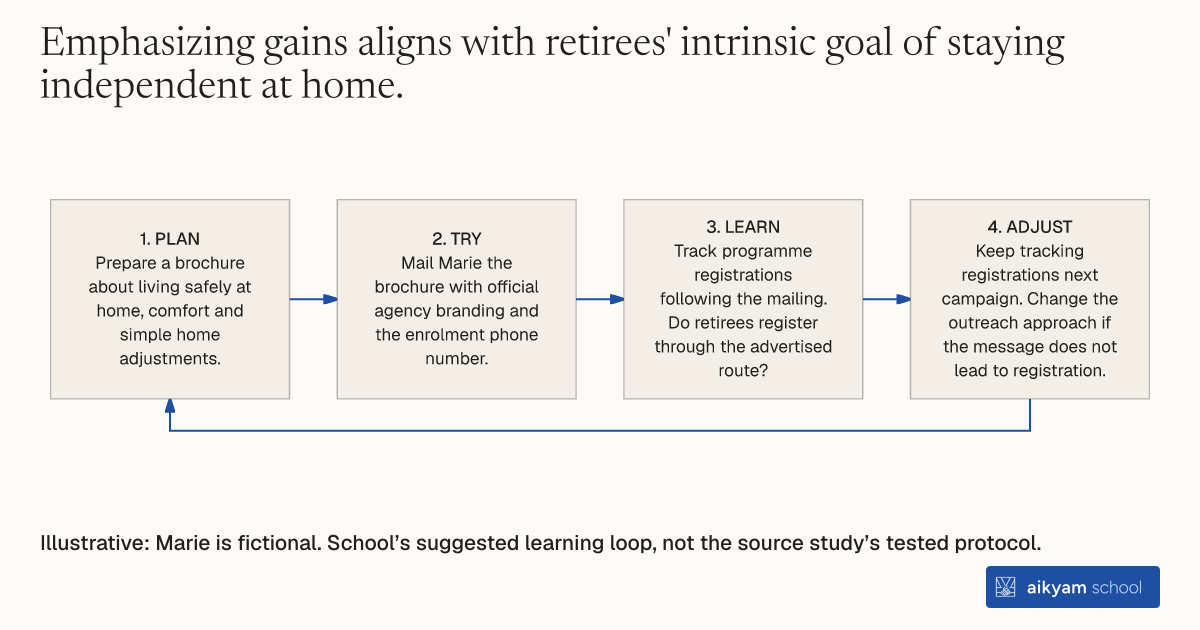
Try, learn and adjust
Check response to messages about independent living
- Plan: Prepare a brochure about living safely at home, comfort and simple home adjustments.
- Try: Mail Marie the brochure with official agency branding and the enrolment phone number.
- Learn: Track programme registrations following the mailing. Do retirees register through the advertised route?
- Adjust: Keep tracking registrations next campaign. Change the outreach approach if the message does not lead to registration.
Illustrative: Marie is fictional. School’s suggested learning loop, not the source study’s tested protocol.
See source →School’s suggested, untested loop. Observe registrations; this local check does not establish that framing caused a change.
How
When to use
Elderly retirees often delay preventive home modifications because traditional health warnings focus on disability and loss of autonomy. This method uses gain-framed communication to emphasize positive outcomes—such as preserving independence, daily comfort, and safety at home—to motivate action. It is designed for public health and social security agencies seeking to encourage health risk prevention without inducing fear or defensiveness.
Frame outreach materials around the positive benefits of remaining independent and safely self-sufficient at home.
- Design outreach brochures featuring headline messages focused on autonomy, such as "Adapting your accommodations means continuing to safely live at home."
- Highlight how simple home adjustments (e.g., support bars, lower bed heights, non-slip flooring) enhance daily living comfort.
- Present home modifications as a proactive choice to maintain long-term independence.
- Include clear contact information for the agency's dedicated enrollment phone line.
- Mail the gain-framed communication directly to retired individuals under official pension agency branding.
Why it works
When individuals already expect potential health declines, loss-framed warnings offer little new motivation, whereas gain-framed messaging provides positive reinforcement to adopt preventive modifications.
Example
In Île-de-France, CNAV mailed Brochure 12 (emphasizing gains of remaining valid at home) to 3,006 retirees, increasing program registration to 1.60% compared to 0.93% in the control group.
About the study
Participants
48,090 retired individuals living in Île-de-France (Paris region), France; 3,006 received Brochure 12.
Study Design
Randomized controlled trial (field experiment) comparing gain-framed brochure messaging against loss-framed messaging and control groups over a 17-month follow-up period.
Results
Gain-framed communication significantly increased program registration by 0.67 percentage points (from 0.93% in the control group to 1.60%, a 72% relative increase; p = 0.008, FDR p = 0.024). In contrast, loss-framed communication had no statistically significant effect (+0.20 percentage points; FDR p = 0.231).