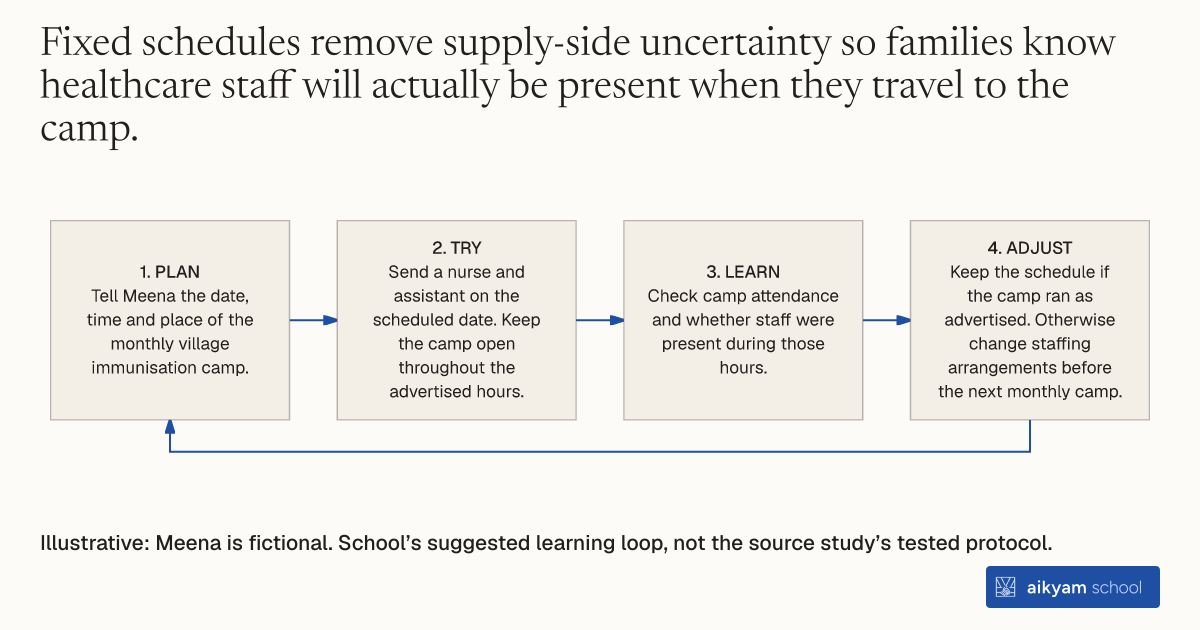
Try, learn and adjust
Check camps run at their advertised times
- Plan: Tell Meena the date, time and place of the monthly village immunisation camp.
- Try: Send a nurse and assistant on the scheduled date. Keep the camp open throughout the advertised hours.
- Learn: Check camp attendance and whether staff were present during those hours.
- Adjust: Keep the schedule if the camp ran as advertised. Otherwise change staffing arrangements before the next monthly camp.
Illustrative: Meena is fictional. School’s suggested learning loop, not the source study’s tested protocol.
See source →School’s suggested learning loop: observe camp reliability and attendance; this does not establish vaccination effects.
How
When to use
Public health programs in remote rural areas frequently fail because static clinics are closed and unpredictable. Organizing travelling immunization camps on fixed, well-publicized dates brings dependable preventive healthcare directly to isolated communities. This method provides rural families with a predictable opportunity to vaccinate their young children.
Provide reliable access to child immunization by holding travelling mobile health camps in rural villages on fixed and well-publicized schedules.
- NGO administrators schedule monthly travelling immunization camps in target rural villages.
- Field staff publicize the exact date, time, and location of each camp to local families in advance.
- A nurse and assistant travel to the village on the scheduled date to set up the mobile camp.
- Health personnel remain at the camp site throughout the advertised hours to administer vaccines to arriving children.
- Village health workers track attendance and remind parents of upcoming monthly camp dates.
Why it works
Creating monthly deadlines also creates a natural urgency that helps counteract procrastination among parents.
Example
Seva Mandir conducted monthly travelling immunization camps on fixed dates across rural villages in Udaipur, Rajasthan. The reliable mobile camps increased full child immunization rates from 6% in comparison villages to 18% in treatment villages, costing about \$56 per fully immunized child.
About the study
Participants
Poor tribal households with children aged 1 to 3 years across rural villages in Udaipur district, Rajasthan, India.
Study Design
A clustered randomized controlled evaluation comparing villages receiving monthly mobile immunization camps against comparison villages with no additional intervention.
Results
Reliable mobile immunization service alone increased full immunization rates among children aged 1 to 3 from 6% to 18%, at a cost of about \$56 per child immunized.