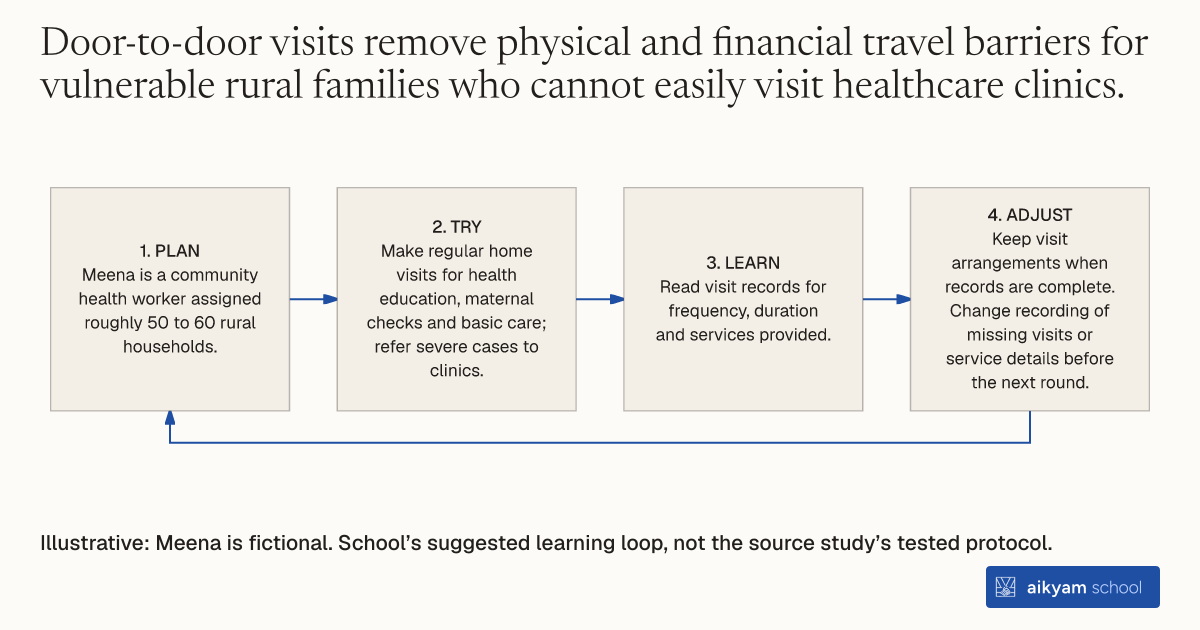
Try, learn and adjust
Check household visit coverage
- Plan: Meena is a community health worker assigned roughly 50 to 60 rural households.
- Try: Make regular home visits for health education, maternal checks and basic care; refer severe cases to clinics.
- Learn: Read visit records for frequency, duration and services provided.
- Adjust: Keep visit arrangements when records are complete. Change recording of missing visits or service details before the next round.
Illustrative: Meena is fictional. School’s suggested learning loop, not the source study’s tested protocol.
See source →School’s suggested learning loop checks visit records, separately from the study’s home care services. This loop is not a clinical protocol.
How
When to use
Rural households in developing countries often lack access to basic preventative healthcare, maternal check-ups, and pediatric medical referrals. Local community health workers deliver door-to-door health services directly to families in their assigned villages. This doorstep delivery system addresses geographic barriers and expands primary healthcare coverage for expectant mothers and young children.
Deliver primary health services directly to rural households through structured community health worker home visits.
- Assign each community health worker to a catchment area of roughly 50 to 60 rural households.
- Visit assigned households regularly to provide routine health check-ups and education.
- Conduct pre-natal and post-natal health examinations for pregnant women and newborns.
- Deliver basic medical treatment for common childhood illnesses like malaria, diarrhea, and fever.
- Refer severe medical cases directly to local peripheral health units for clinic care.
- Spend approximately 12 to 15 minutes per household visit delivering services and answering health questions.
Why it works
Providing preventative check-ups and early medical referrals at home reduces severe health complications among mothers and young children.
Example
In Sierra Leone, 2,009 community health workers provided primary care home visits across 372 peripheral health units covering rural villages. Each worker managed an average of 57 households, delivering routine health checks, maternal visits, and basic treatments while spending an average of 15 minutes per home visit.
About the study
Participants
2,009 Community Health Workers and primary female caregivers across 372 Peripheral Health Units in Sierra Leone.
Study Design
Randomized Controlled Trial measuring household visit quantity, visit duration, and health service types from random household surveys across 10% of village households over a 10-month study period.
Results
Community health workers in the control group provided an average of 6.75 household visits over six months, lasting an average of 11.99 minutes per visit. Meritocratic promotion incentives increased visit volume by 22% (+1.497 visits) and average visit length by 15%.