Research steps
Measure child health after sanitation delivery
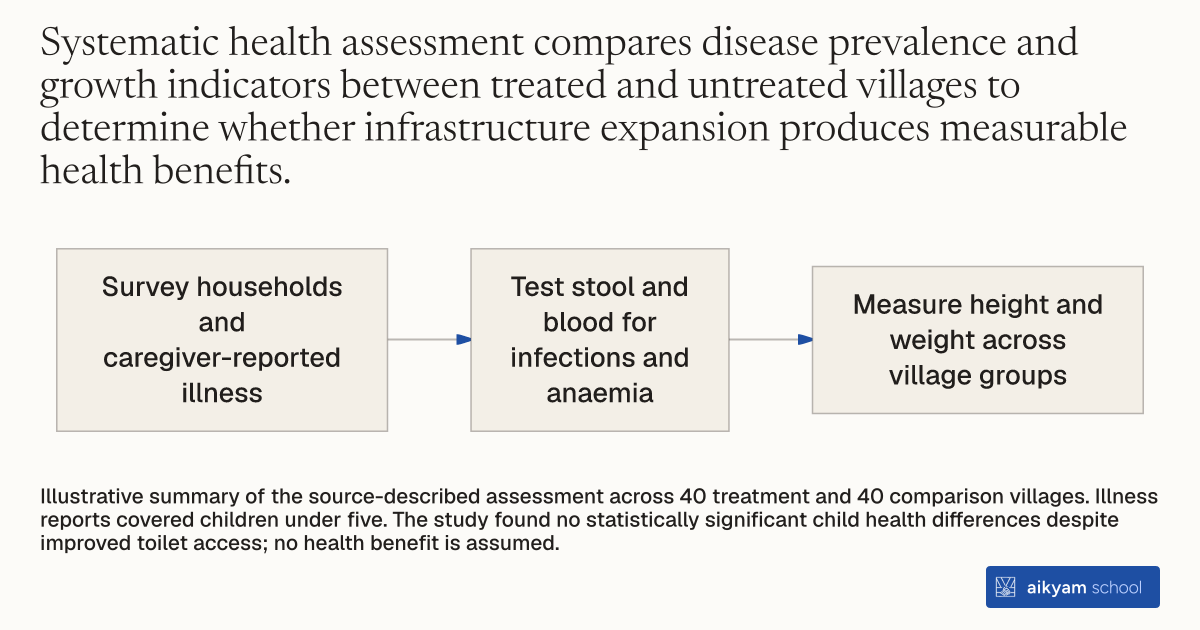
- Survey households and caregiver-reported illness
- Test stool and blood for infections and anaemia
- Measure height and weight across village groups
Illustrative summary of the source-described assessment across 40 treatment and 40 comparison villages. Illness reports covered children under five. The study found no statistically significant child health differences despite improved toilet access; no health benefit is assumed.
See source →How
When to use
Open defecation spreads intestinal infections and diarrheal illness among young children in rural communities. Sanitation interventions aim to improve child health outcomes by reducing pathogen exposure in village environments. This assessment measures changes in caregiver-reported illness, intestinal infections, anemia, and child growth following sanitation campaign implementation.
Evaluate child health outcomes and defecation habits following community-wide sanitation campaign delivery.
- Survey enumerators visit sample households across treatment and comparison villages.
- Field staff collect caregiver-reported illness data for children under five years of age.
- Health workers test stool and blood samples to record intestinal infections and anemia prevalence among young children.
- Trained staff measure child height and weight to assess anthropometric growth indicators across treatment and comparison groups.
Example
In rural Madhya Pradesh, India, researchers assessed child health across 80 villages where 40 treatment villages received the Total Sanitation Campaign. Despite expanding WHO-compliant toilet availability to 41.4 percent of treatment households, the assessment found no statistically significant reduction in caregiver-reported illness, intestinal infections, anemia, or child growth deficits compared to comparison villages.
About the study
Participants
80 rural villages across two districts in Madhya Pradesh, India, sampling households with children under five years of age and children under 24 months of age.
Study Design
Cluster randomized controlled trial evaluating health and behavioral differences between 40 treatment villages and 40 comparison villages.
Results
Improved toilet access increased to 41.4 percent (a 19 percentage point rise over comparison villages) and daily open defecation decreased by 11 to 12 percent, but more than 70 percent of villagers continued daily open defecation and child health outcomes showed no significant differences in diarrhea, anemia, intestinal infections, or growth.