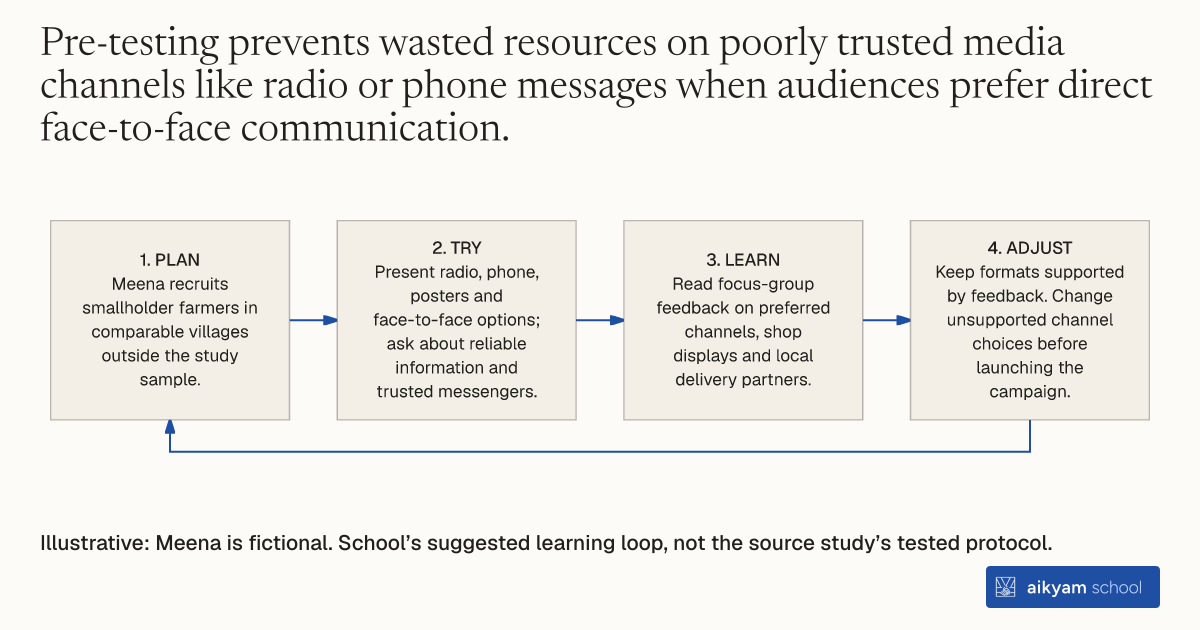
Try, learn and adjust
Check communication choices with farmers
- Plan: Meena recruits smallholder farmers in comparable villages outside the study sample.
- Try: Present radio, phone, posters and face-to-face options; ask about reliable information and trusted messengers.
- Learn: Read focus-group feedback on preferred channels, shop displays and local delivery partners.
- Adjust: Keep formats supported by feedback. Change unsupported channel choices before launching the campaign.
Illustrative: Meena is fictional. School’s suggested learning loop, not the source study’s tested protocol.
See source →School’s suggested learning loop checks channel preferences, separately from the two focus groups with 40 farmers used to design the intervention.
How
When to use
Program designers often guess which media channels or message formats will persuade target rural populations. Launching information campaigns without testing local communication preferences risks using ineffective media channels. Program managers use this method to pre-test intervention formats with target audiences before field deployment.
Conduct structured focus group discussions with community members in non-sample areas to evaluate potential information channels and delivery partners.
- Select representative non-sample villages that share demographic characteristics with the target program area.
- Recruit diverse smallholder farmers to attend structured focus group discussions.
- Present proposed communication channels such as radio broadcasts, phone messages, posters, and face-to-face meetings.
- Elicit participant feedback on where they usually obtain reliable market information and which delivery actors they trust.
- Identify point-of-sale visual preferences, such as large colorful posters and shop counter pamphlets.
- Select final intervention channels and trusted local delivery partners based on focus group consensus.
Why it works
Consulting local communities ensures materials match local information-seeking habits.
Example
Researchers held two focus group discussions with 40 farmers in non-sample villages in Singida Region, Tanzania. Farmers rejected radio and phone options, recommending large colorful posters at agro-dealer shops and village meetings hosted by government extension agents.
About the study
Participants
40 farmers across 2 non-sample villages in Singida Region, Tanzania.
Study Design
Qualitative focus group pre-testing assessing communication channels prior to intervention design.
Results
Focus group consensus led researchers to replace planned media and phone channels with shopfront posters, counter pamphlets, and extension-led village meetings.