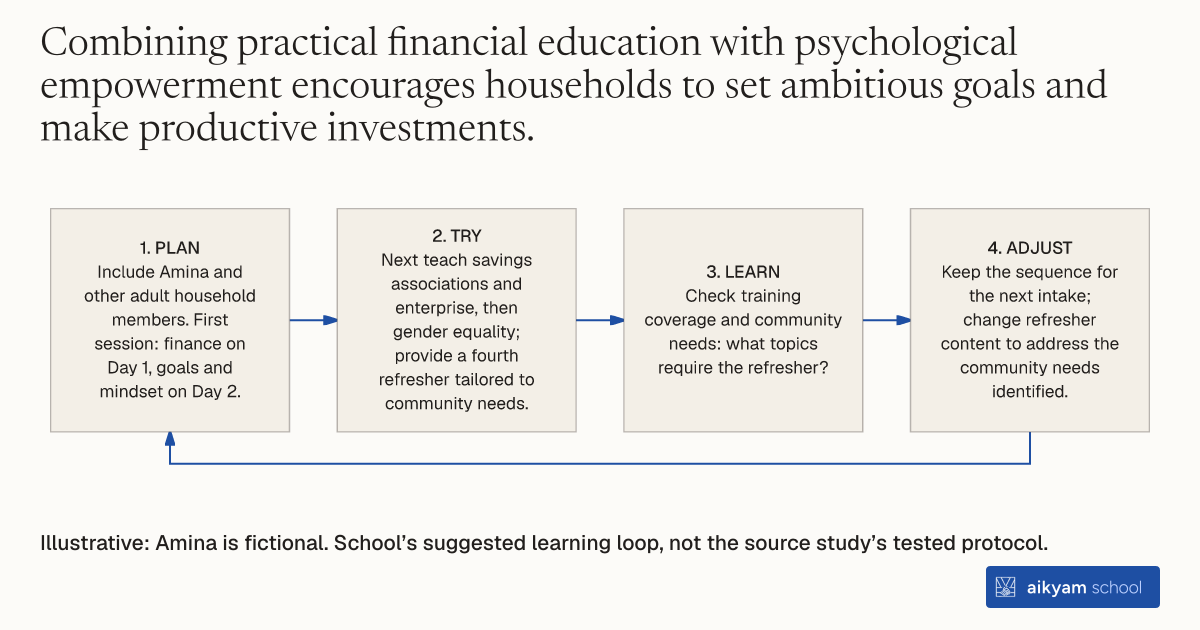
Try, learn and adjust
Check the four training sessions retain their order
- Plan: Include Amina and other adult household members. First session: finance on Day 1, goals and mindset on Day 2.
- Try: Next teach savings associations and enterprise, then gender equality; provide a fourth refresher tailored to community needs.
- Learn: Check training coverage and community needs: what topics require the refresher?
- Adjust: Keep the sequence for the next intake; change refresher content to address the community needs identified.
Illustrative: Amina is fictional. School’s suggested learning loop, not the source study’s tested protocol.
See source →School’s suggested, untested learning loop. Observe the four-session sequence and refresher coverage; this check does not isolate training effects from the livelihoods package.
How
When to use
Rural households in low-income regions often face psychological barriers, limited financial skills, and gender inequalities that hinder economic initiative and enterprise growth. Delivering structured training on personal finance, mindset change, business management, and gender dynamics builds self-efficacy and financial capacity. This approach is intended for impoverished agricultural communities starting or expanding small businesses and savings activities.
Deliver a four-part training sequence on financial literacy, growth mindset, entrepreneurship, and gender equality to all adult household members in rural communities.
- Conduct the first two-day training, dedicating Day 1 to financial planning, budgeting, cash flow management, and savings resources, and Day 2 to goal setting, overcoming obstacles, aspirations, and growth mindset.
- Deliver the second training on Village Savings and Loan Associations and entrepreneurship, covering business investment, funding acquisition, marketing, and performance tracking.
- Conduct the third training on gender equality, roles, and responsibilities, facilitating discussions on questioning gender roles, income generation impacts, and domestic violence.
- Provide a fourth refresher training session tailored to specific community needs during program implementation.
Why it works
Addressing gender roles and intra-household cooperation enables families to maximize their collective earning potential.
Example
In rural western Uganda, Raising the Village delivered four training modules on mindset change and financial literacy to households in treated villages, contributing to a 37% increase in business profits and raising the mental health index by 0.207 standard deviations.
About the study
Participants
3,852 households across 335 villages in Kagadi and Kyenjojo districts, western Uganda, where 35% of households fall below the \$2.15 PPP daily poverty line post-harvest and 65% during the lean season.
Study Design
Clustered randomized controlled trial across 114 village clusters covering 335 villages, comparing a universal livelihoods program to a pure control group.
Results
Business profits increased by 37% (USD 12.351 PPP per month, p < 0.01), mental health index increased by 0.207 standard deviations (p < 0.01), aspirations index increased by 0.093 standard deviations (p < 0.01), and depression likelihood dropped by 5.6 percentage points (p < 0.01).