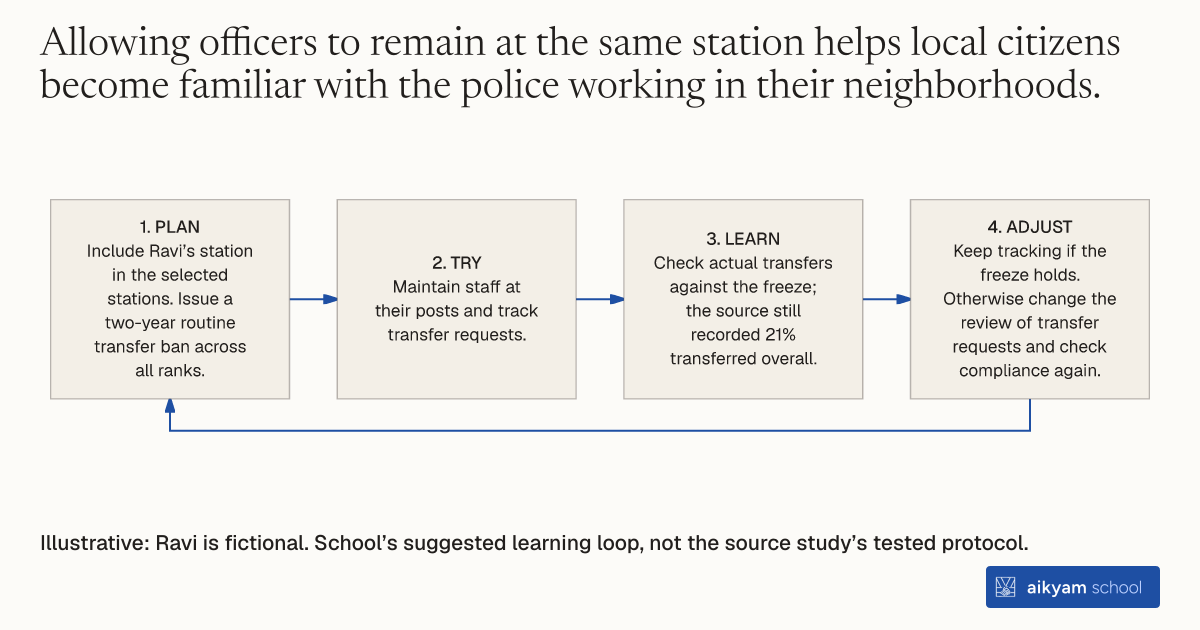
Try, learn and adjust
Check compliance with a police transfer freeze
- Plan: Include Ravi’s station in the selected stations. Issue a two-year routine transfer ban across all ranks.
- Try: Maintain staff at their posts and track transfer requests.
- Learn: Check actual transfers against the freeze; the source still recorded 21% transferred overall.
- Adjust: Keep tracking if the freeze holds. Otherwise change the review of transfer requests and check compliance again.
Illustrative: Ravi is fictional. School’s suggested learning loop, not the source study’s tested protocol.
See source →School’s suggested learning loop, not the source’s tested procedure. Observe transfer requests and actual movement. This check alone does not establish changes in citizens’ fear.
How
When to use
Frequent administrative transfers disrupt law enforcement operations and prevent police officers from building relationships with local communities. This problem creates widespread public mistrust and fear of police personnel among citizens. Police departments use transfer freezes for station staff to ensure continuous community presence and personnel stability.
Freeze administrative police transfers across local stations for at least two years to build stability.
- Police leadership selects police stations to participate in the administrative transfer freeze.
- Department administrators issue a directive banning routine transfers of officers across all ranks for two years.
- Station supervisors maintain assigned police staff at their posts throughout the two-year period.
- Department officials track transfer requests to limit administrative movement across stations.
Why it works
Increased familiarity reduces citizens' fear and builds public trust in law enforcement personnel.
Example
The Rajasthan Police in India attempted to freeze transfers for all ranks across treated police stations over two years. Although twenty-one percent of officers were still transferred, the policy reduced transfers by sixty percent for certain ranks and lowered citizens' fear of the police by thirteen to twenty-four percentage points.
About the study
Participants
162 police stations in 11 districts across Rajasthan, India, serving 70,767 police personnel and 5,895 households.
Study Design
A randomized controlled trial evaluated police stations assigned to freeze administrative transfers against control stations over two years using household surveys and case file reviews.
Results
A 60 percent reduction in transfers for some ranks reduced citizens' fear of the police by 13 to 24 percentage points, despite an overall transfer rate of 21 percent across all ranks.