Procedure
Place community observers in police stations
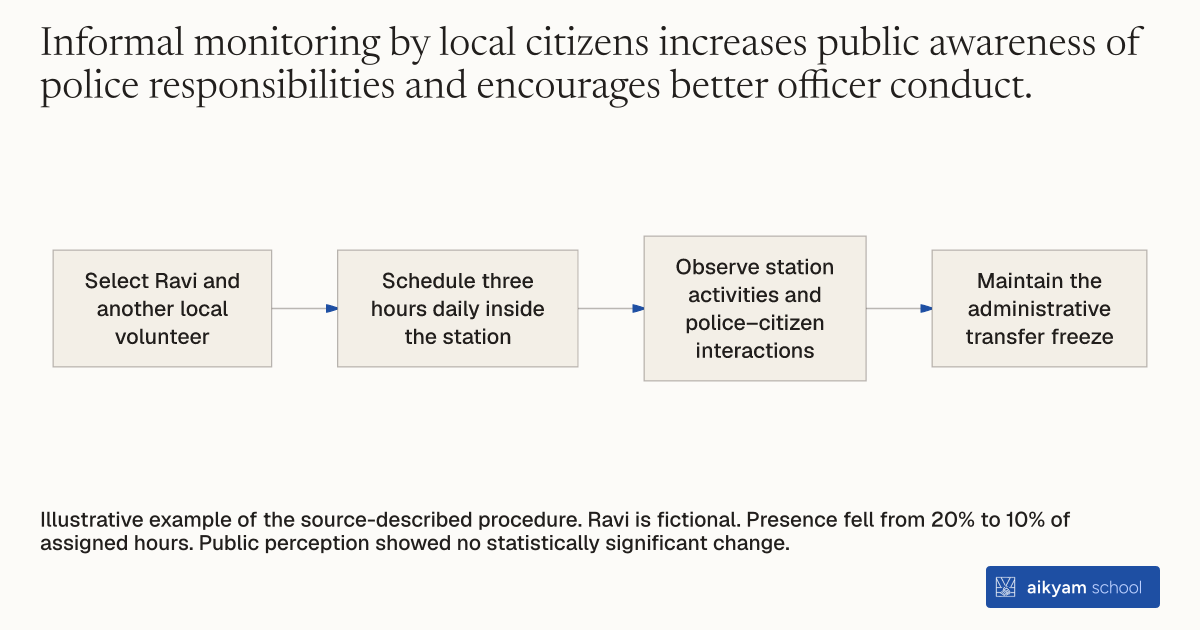
- Select Ravi and another local volunteer
- Schedule three hours daily inside the station
- Observe station activities and police–citizen interactions
- Maintain the administrative transfer freeze
Illustrative example of the source-described procedure. Ravi is fictional. Presence fell from 20% to 10% of assigned hours. Public perception showed no statistically significant change.
See source →How
When to use
Police departments face public distrust and lack transparency in daily station operations. Citizens often hesitate to report crimes due to fear of police mistreatment or backlash. Local police stations invite community volunteers to observe station activities to build public trust and improve officer behavior.
Establish an informal monitoring system by placing local volunteers inside police stations to observe daily activities.
- Station supervisors select two local volunteers from the community to serve as observers.
- Station leaders schedule volunteers to sit inside the police station for three hours each day.
- Community observers observe day-to-day station activities and interactions between officers and citizens.
- Department administrators maintain an administrative transfer freeze across participating stations during the program.
Why it works
Observing routine interactions creates external accountability without requiring formal disciplinary mechanisms.
Example
The Rajasthan Police in India asked police stations to host two community observers for three hours daily. Observer presence started at twenty percent of assigned hours and quickly dropped to ten percent, resulting in no detectable impact on public perception of the police.
About the study
Participants
162 police stations in 11 districts across Rajasthan, India, serving 70,767 police personnel and 5,895 households.
Study Design
A randomized controlled trial evaluated police stations assigned to host community observers against comparison stations using household surveys and station observation records over two years.
Results
Observer presence declined from an initial 20 percent of assigned hours to 10 percent over time, producing no statistically significant change in public perception of the police.