Research procedure
Audit complaint registration with decoy visits
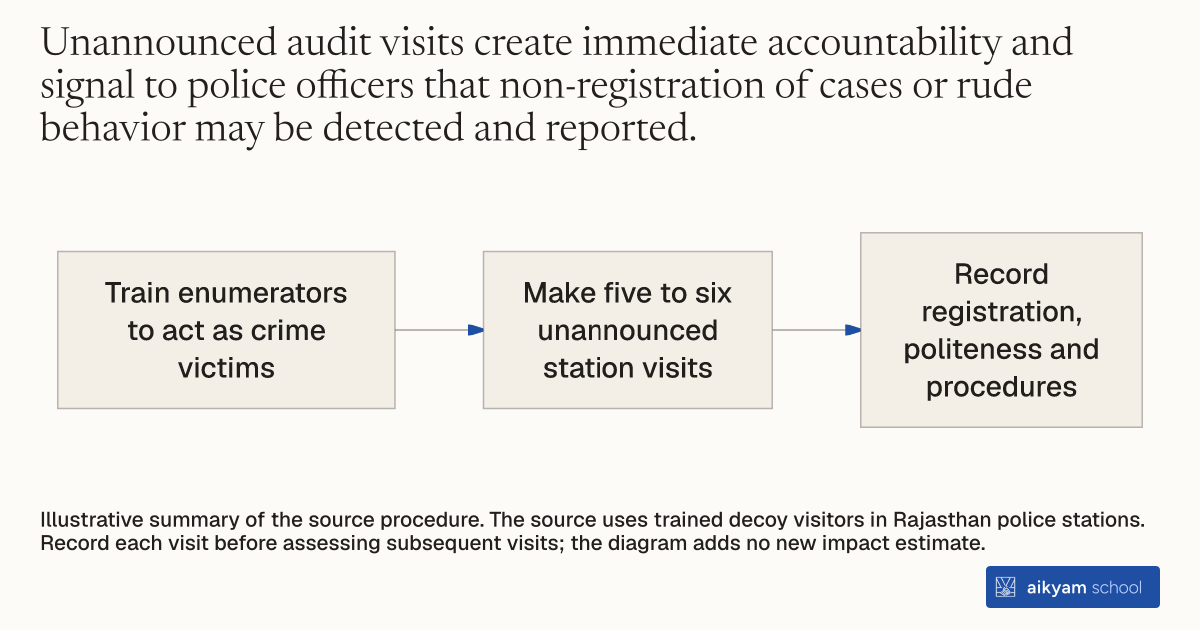
- Train enumerators to act as crime victims
- Make five to six unannounced station visits
- Record registration, politeness and procedures
Illustrative summary of the source procedure. The source uses trained decoy visitors in Rajasthan police stations. Record each visit before assessing subsequent visits; the diagram adds no new impact estimate.
See source →How
When to use
Police stations often refuse to register crime complaints or mistreat citizens who attempt to report offenses. This problem leads to widespread unreported crime, public distrust, and a lack of officer accountability. Police leadership sends undercover enumerators pretending to be crime victims to evaluate officer responsiveness and enforce case registration standards.
Send unannounced decoy crime victims to local police stations to test officer willingness to register complaints and evaluate police behavior.
- Research supervisors hire survey enumerators to act as ordinary citizens seeking to register crime complaints.
- Program instructors train enumerators to dress normally and pretend to be local crime victims.
- Program managers dispatch enumerators to conduct five to six unannounced decoy visits per police station.
- Decoy visitors present complaint details to station officers and request official case registration.
- Survey personnel evaluate and record officer politeness, willingness to register cases, and station procedures after each visit.
Why it works
Repeated visits reinforce compliance and motivate station staff to treat citizens politely and register complaints consistently.
Example
Researchers dispatched five to six decoy crime victims to treated police stations across Rajasthan, India, which increased subsequent case registration likelihood by 22 percentage points (from a 48 percent baseline) and improved citizen perceptions of officer politeness by 7.9 to 11.5 percentage points.
About the study
Participants
162 police stations in 11 districts across Rajasthan, India, serving 70,767 police personnel and 5,895 households.
Study Design
A randomized controlled trial evaluated police stations assigned to receive unannounced visits by survey enumerators acting as crime victims against comparison stations using follow-up decoy visits and household surveys.
Results
Each decoy visit increased the likelihood of case registration during the next visit by 22 percentage points (a 46 percent increase over the 48 percent baseline) and improved perceptions of officer politeness by 7.9 to 11.5 percentage points (a 35 to 55 percent increase over a 20 percent baseline).