Try, learn and adjust
Check job search plans during caseworker meetings
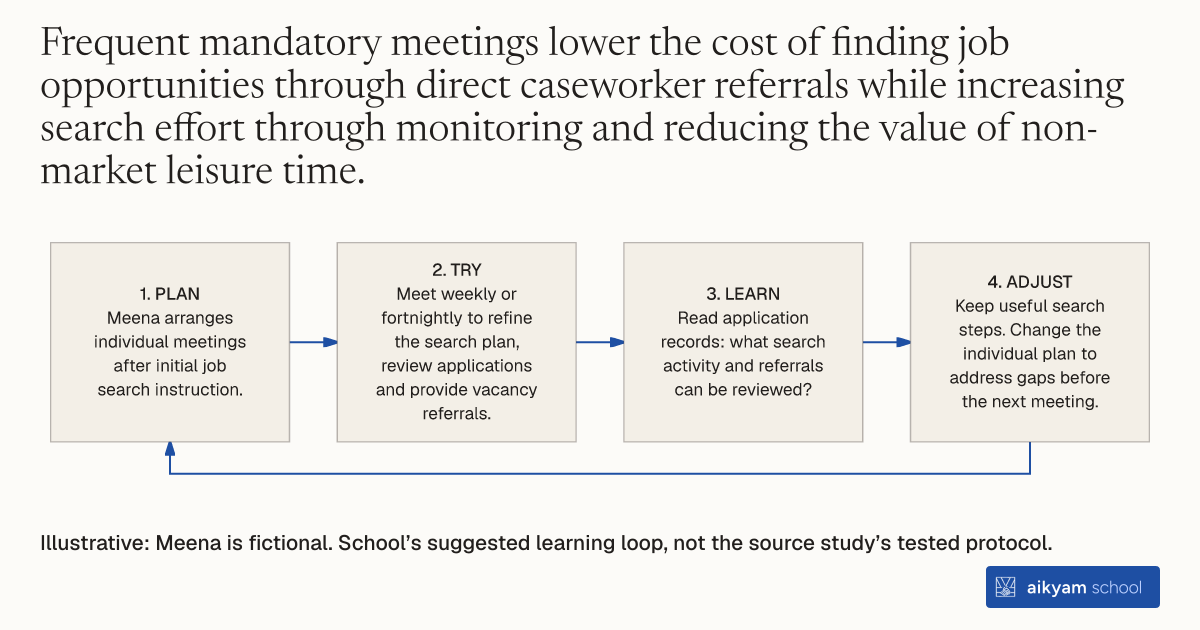
- Plan: Meena arranges individual meetings after initial job search instruction.
- Try: Meet weekly or fortnightly to refine the search plan, review applications and provide vacancy referrals.
- Learn: Read application records: what search activity and referrals can be reviewed?
- Adjust: Keep useful search steps. Change the individual plan to address gaps before the next meeting.
Illustrative: Meena is fictional. School’s suggested learning loop, not the source study’s tested protocol.
See source →Observe meeting frequency, application records and search plans; do not infer employment effects from meetings alone. School suggests this learning loop; it is not the source’s tested procedure.
How
When to use
Unemployed workers receiving benefit payments require ongoing supervision and advice after initial job search instruction. Program managers want to maintain high job search effort and monitor compliance throughout an unemployment spell. Conducting frequent individual meetings with caseworkers provides direct counseling, search monitoring, and job referrals.
Schedule recurring individual counseling and monitoring meetings between unemployed job seekers and public employment caseworkers.
- Assign newly registered benefit recipients to meet individually with a dedicated caseworker after initial job search instruction.
- Hold individual monitoring and counseling meetings every week or every two weeks during the unemployment spell.
- Formulate and refine a tailored individual job search plan with the worker during meetings.
- Review and monitor the worker's submitted job search effort and application records.
- Provide job seeker matches and direct vacancy referrals during the counseling sessions.
Why it works
Unemployed workers search more actively to secure employment.
Example
Public employment offices in Storstrøm and South Jutland conducted weekly or biweekly caseworker meetings with 1,814 unemployed benefit recipients starting after five to six weeks of unemployment between November 2005 and February 2006. Treated participants found work faster, with 92.6% exiting unemployment within one year compared to 88.8% in the control group.
About the study
Participants
1,814 newly unemployed benefit recipients assigned to treatment out of 3,751 trial participants across Storstrøm and South Jutland, Denmark.
Study Design
Randomized controlled trial assigning job seekers born on the 1st through 15th of the month to mandatory caseworker meetings, evaluated using proportional hazard models and administrative tracking data.
Results
Mandatory caseworker meetings and activation increased exit rates to employment by 20% compared to no program, raising the 3-month exit probability by 7.0 percentage points.