Research steps
Prepare job-fair match recommendations
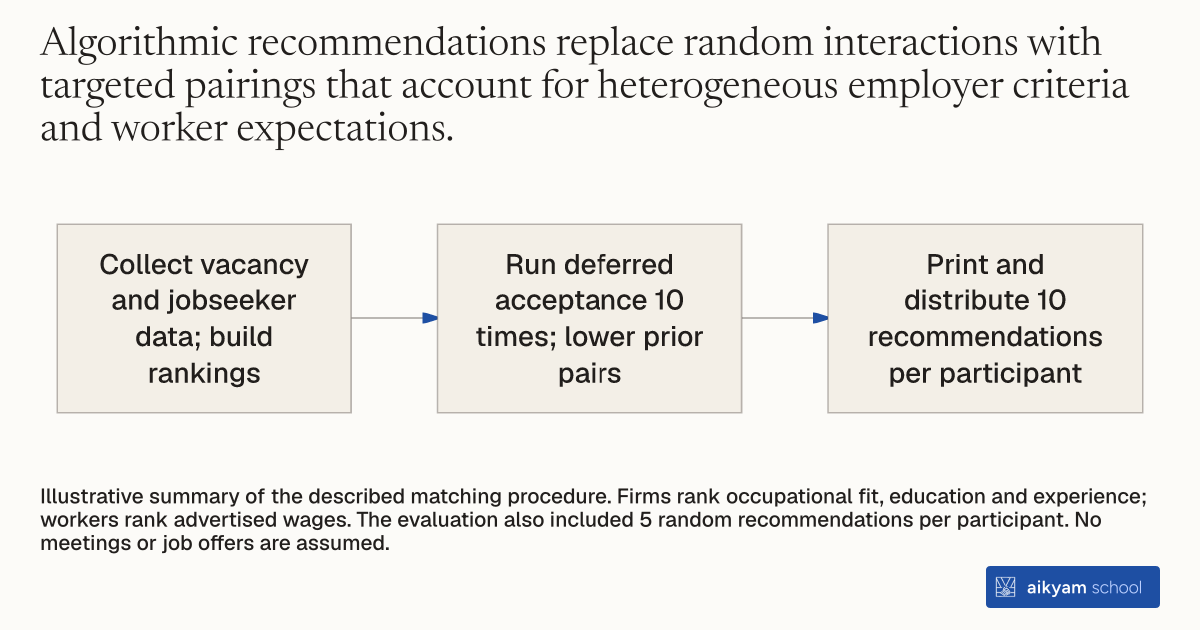
- Collect vacancy and jobseeker data; build rankings
- Run deferred acceptance 10 times; lower prior pairs
- Print and distribute 10 recommendations per participant
Illustrative summary of the described matching procedure. Firms rank occupational fit, education and experience; workers rank advertised wages. The evaluation also included 5 random recommendations per participant. No meetings or job offers are assumed.
See source →How
When to use
Use this method when organizing large physical matching events between jobseekers and employers where attendee numbers cause high congestion and search inefficiency. It solves the problem of wasted time and random encounters between incompatible candidates and firms. It serves event organizers, employment agencies, and market designers structuring crowded recruitment fairs.
Generate personalized match recommendations by running an iterated deferred acceptance algorithm on synthetic candidate and vacancy rankings prior to a matching event.
- Survey participating firms before the event to list open vacancies, required occupational experience, education levels, and advertised wages.
- Collect jobseeker baseline survey data on education, previous occupation, and wage expectations.
- Construct synthetic firm preferences by ranking candidates lexicographically based on occupational match, educational qualification, and years of wage employment.
- Construct synthetic jobseeker preferences by ranking firm vacancies according to advertised wages.
- Execute the Gale-Shapley Deferred Acceptance algorithm to generate stable worker-firm match pairs.
- Iterate the algorithm 10 times while moving previously assigned pairs to the bottom of rankings to produce 10 distinct recommendations per participant.
- Print personalized recommendation sheets listing suggested firm booths or candidate names and distribute them to attendees upon event arrival.
Why it works
This reduces queueing congestion and directs event participants toward mutually beneficial screening interviews.
Example
Event organizers at two job fairs in Addis Ababa, Ethiopia generated 10 algorithmic recommendations and 5 random recommendations for each of 606 attending jobseekers and 170 attending firms. Matches suggested by the algorithm were about 200 percent more likely to result in actual face-to-face meetings than non-suggested matches.
About the study
Participants
N = 27,778 worker-firm pairings from 606 jobseekers and 170 formal employers in Addis Ababa, Ethiopia.
Study Design
Randomized field experiment evaluating dyadic meeting outcomes of Gale-Shapley Deferred Acceptance recommendations versus 5 random match recommendations.
Results
Matches suggested by the algorithm were 200 percent more likely to take place than non-suggested matches (p < 0.01), whereas randomly suggested matches showed no statistically significant effect (p > 0.10).