Research labour tracking
Compare farm work by gender and role
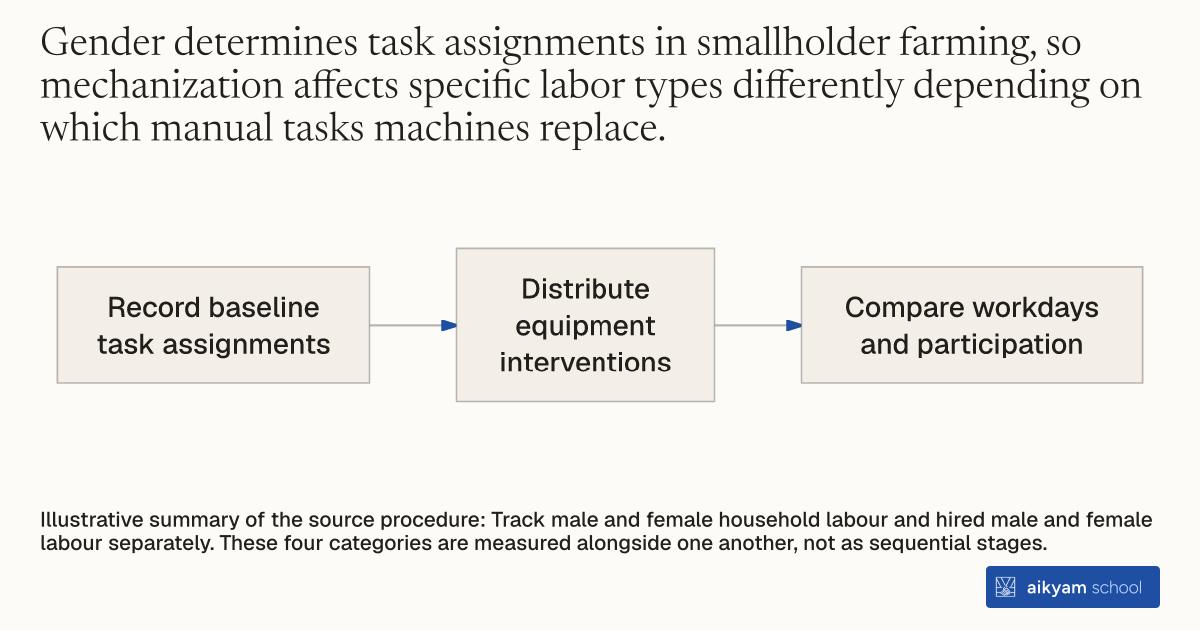
- Record baseline task assignments
- Distribute equipment interventions
- Compare workdays and participation
Illustrative summary of the source procedure: Track male and female household labour and hired male and female labour separately. These four categories are measured alongside one another, not as sequential stages.
See source →How
When to use
In smallholder agriculture, mechanization alters labor requirements, but tasks are heavily gender-segregated between male and female workers across family and hired roles. Measuring overall labor without disaggregating by gender and employment status conceals how machinery impacts specific workers. Evaluating labor across four distinct categories—male household, female household, hired male, and hired female labor—reveals true labor reallocation patterns.
Track household and hired labor disaggregated by gender to evaluate how farm mechanization alters labor allocation across specific agricultural tasks.
- Identify baseline task assignments for male family members, female family members, hired male workers, and hired female workers across the farming season.
- Distribute agricultural equipment rental vouchers or interventions to target farming households.
- Measure changes in male household labor days and participation rates during land preparation and managerial activities.
- Measure changes in female household labor days and participation rates during sowing, weeding, transplanting, and harvesting.
- Track working days and participation rates for hired male laborers and hired female laborers separately.
- Calculate the ratio of hired workers to male family members performing supervisory duties to determine managerial leverage shifts.
Why it works
Disaggregating labor shows whether machinery reduces arduous household labor or substitutes for hired farm workers.
Example
Researchers evaluated labor reallocation among 7,100 smallholders in Karnataka, India, after offering equipment rental vouchers. Male household labor declined by 16 percentage points (2.3 days) and female household labor declined by 16.6 percentage points (1.5 days), while hired male labor stayed constant and hired female labor fell by 12 percentage points (4.4 days).
About the study
Participants
7,100 small-scale farmers across 190 villages in eight districts of Karnataka, India, with 5,500 completing the final phone survey.
Study Design
Randomized controlled trial measuring labor outcomes across male household, female household, hired male, and hired female labor categories following equipment voucher distribution.
Results
Male household labor declined by 16 percentage points (2.3 days), female household labor declined by 16.6 percentage points (1.5 days), hired male labor remained unchanged, hired female labor fell by 12 percentage points (4.4 days), and the supervisory ratio increased by 6.5 percentage points.