Research steps
Track household fuel use over time
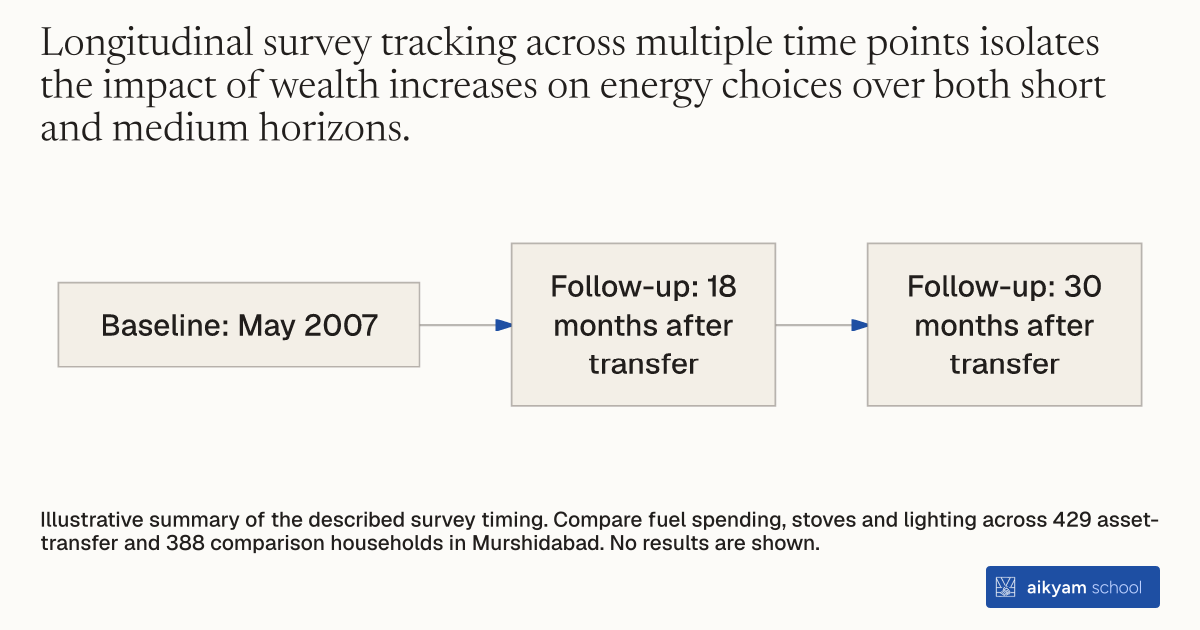
- Baseline: May 2007
- Follow-up: 18 months after transfer
- Follow-up: 30 months after transfer
Illustrative summary of the described survey timing. Compare fuel spending, stoves and lighting across 429 asset-transfer and 388 comparison households in Murshidabad. No results are shown.
See source →How
When to use
Development programs evaluating household well-being need to measure how income growth alters energy expenditure patterns over time. Without tracking specific fuel types alongside general consumption, researchers cannot determine whether economic gains translate into cleaner fuel choices. This method serves researchers and policy evaluators measuring environmental and health impacts of poverty alleviation interventions.
Conduct multi-wave household surveys before and after an economic intervention to track changes in energy consumption and fuel choice.
- Survey managers collect baseline household expenditure data in Murshidabad, West Bengal, India in May 2007.
- Field researchers record baseline stove types, lighting sources, and reliance on solid biomass or kerosene.
- Enumerators re-interview targeted households immediately following the program intervention at 18 months post-transfer.
- Survey teams execute a final follow-up interview 30 months after the initial asset transfer.
- Analysts compare total fuel expenditures, lighting sources, and stove types between asset transfer recipients and comparison households.
Why it works
Disaggregating fuel categories allows evaluators to distinguish between overall energy spending growth and shifts in fuel quality.
Example
In Murshidabad, West Bengal, India, researchers surveyed 817 low-income households at baseline in May 2007, 18 months, and 30 months post-transfer, finding recipient households consumed 12.8 percent more fuel than comparison households.
About the study
Participants
817 low-income households in Murshidabad, West Bengal, India (429 asset transfer group, 388 comparison group).
Study Design
Randomized controlled trial tracking consumption data using household surveys at baseline in May 2007, 18 months post-transfer, and 30 months post-transfer.
Results
Recipient households consumed 12.8 percent more fuel than comparison households, increased electricity lighting use by 4.7 percentage points, and showed a 10.6 percentage point increase in cow dung use.