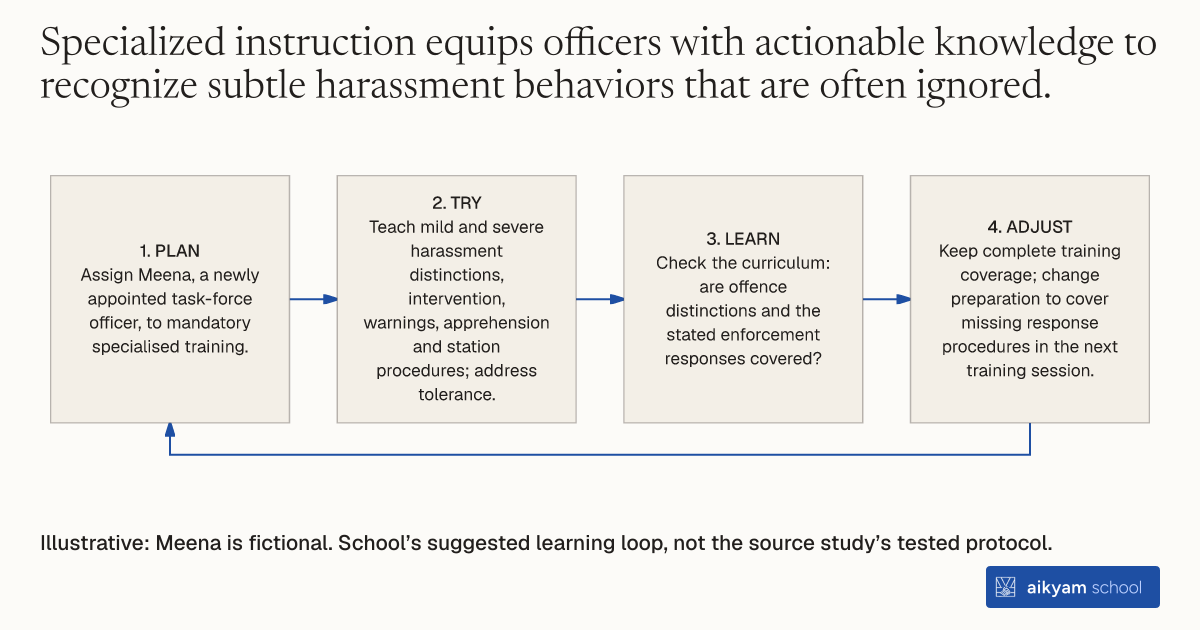
Try, learn and adjust
Check officer training covers response procedures
- Plan: Assign Meena, a newly appointed task-force officer, to mandatory specialised training.
- Try: Teach mild and severe harassment distinctions, intervention, warnings, apprehension and station procedures; address tolerance.
- Learn: Check the curriculum: are offence distinctions and the stated enforcement responses covered?
- Adjust: Keep complete training coverage; change preparation to cover missing response procedures in the next training session.
Illustrative: Meena is fictional. School’s suggested learning loop, not the source study’s tested protocol.
See source →School’s suggested learning loop, not a tested protocol. Observe curriculum coverage and distinctions between mild and severe harassment, not assumed enforcement effects.
How
When to use
Public spaces often suffer from pervasive street harassment, yet police officers may tolerate mild offenses or lack specific protocols to respond effectively. Standard police academy curricula rarely prepare personnel to spot non-physical forms of gender-based crime. Provide specialized formal training to officers assigned to dedicated safety task forces to improve identification and response protocols.
Deliver formal specialized instruction to police task force personnel on identifying, evaluating, and responding to street harassment.
- Design a specialized curriculum focused on identifying mild and severe forms of public sexual harassment.
- Mandate training for all officers newly assigned to dedicated public safety task forces.
- Train officers to distinguish mild offenses such as catcalling and whistling from severe offenses such as stalking and physical intimidation.
- Establish standardized enforcement procedures for intervening in active harassment situations.
- Instruct officers on proper procedures for apprehending offenders, issuing warnings, and bringing perpetrators to police stations.
- Incorporate attitude-focused modules to address officer tolerance of public harassment and promote active enforcement.
Why it works
Attitude-focused training reduces officer tolerance toward gender-based offenses, leading to consistent law enforcement responses in public spaces.
Example
Hyderabad City Police in Hyderabad, India, provided formal anti-harassment training to all 72 officers assigned to its specialized Safety, Health, and Environment Police Unit (SHE Teams).
About the study
Participants
72 officers assigned to SHE Teams in Hyderabad, India.
Study Design
Evaluation of trained SHE Teams officers randomly deployed across 350 public hotspots in uniform, undercover, or comparison conditions.
Results
Officers assigned to the task force received formal training; when deployed in uniform, trained officers achieved a 27 percent reduction in severe sexual harassment across patrolled hotspots.