Research procedure
Vary insurance offers across labour markets
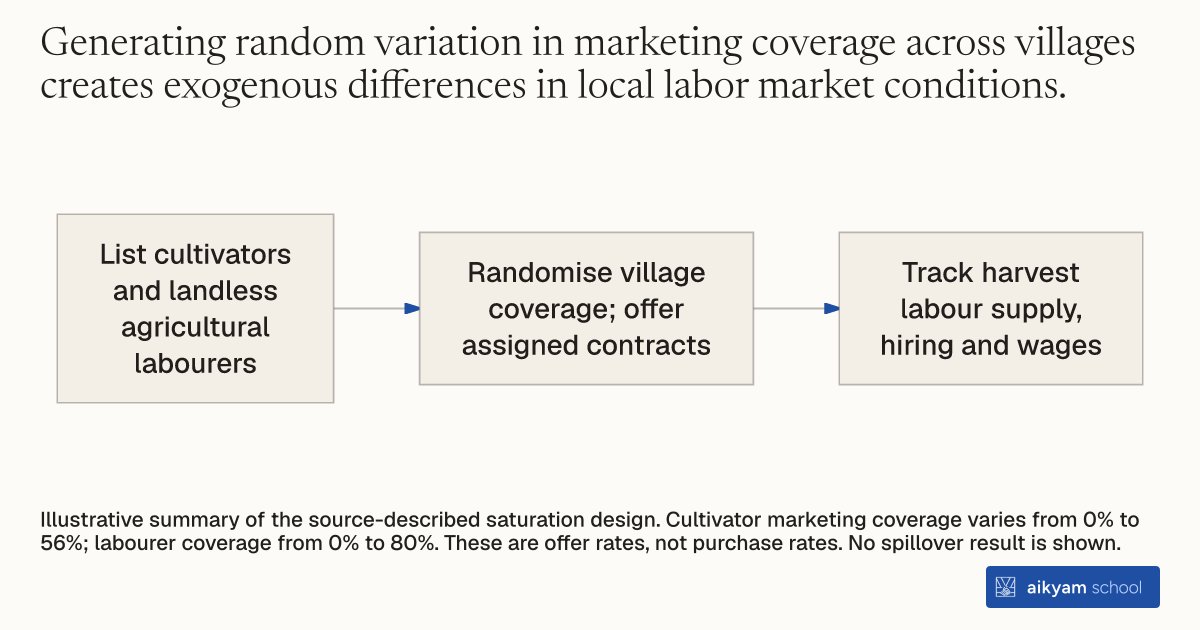
- List cultivators and landless agricultural labourers
- Randomise village coverage; offer assigned contracts
- Track harvest labour supply, hiring and wages
Illustrative summary of the source-described saturation design. Cultivator marketing coverage varies from 0% to 56%; labourer coverage from 0% to 80%. These are offer rates, not purchase rates. No spillover result is shown.
See source →How
When to use
Researchers evaluating market-wide impacts of financial products face difficulties separating individual treatment effects from general equilibrium spillovers. Varying the marketing saturation rate across villages changes the proportion of treated households in local labor markets. This method evaluates village-level labor supply shifts, hiring responses, and wage stability for smallholders and landless workers.
Vary intervention marketing saturation rates across village labor markets to measure general equilibrium spillover effects on local employment and wages.
- Map all cultivator households and landless wage labor households across study villages using census listing data.
- Stratify households by primary occupation into farm-cultivating decision-makers and landless agricultural wage workers.
- Randomize insurance marketing coverage rates across villages, varying cultivator coverage from 0 percent to 56 percent and laborer coverage from 0 percent to 80 percent.
- Offer index rainfall insurance contracts directly to selected households within treatment villages according to assigned saturation rates.
- Track village-level labor supply, male harvest labor hiring, and wage rates across varying market coverage levels during the harvest season.
Why it works
This allows researchers to isolate general equilibrium wage effects and cross-group spillovers from direct product adoption.
Example
Researchers in 63 Indian villages varied cultivator insurance coverage from 0 to 56 percent and landless laborer coverage from 0 to 80 percent, finding that offering insurance to all cultivators increased landless household purchase likelihood by 12 percentage points (31.5 percent).
About the study
Participants
4,667 households across 63 rural Indian villages, where 28.5 percent of heads are landless agricultural wage laborers.
Study Design
Cluster-randomized trial varying insurance offer saturation rates among cultivators (0–56%) and laborers (0–80%) across 42 treatment villages.
Results
Insurance coverage varied from 0% to 56% for cultivators and 0% to 80% for laborers across treatment villages; landless households were 12 percentage points (31.5%) more likely to purchase insurance when all village cultivators received offers compared to zero cultivators.