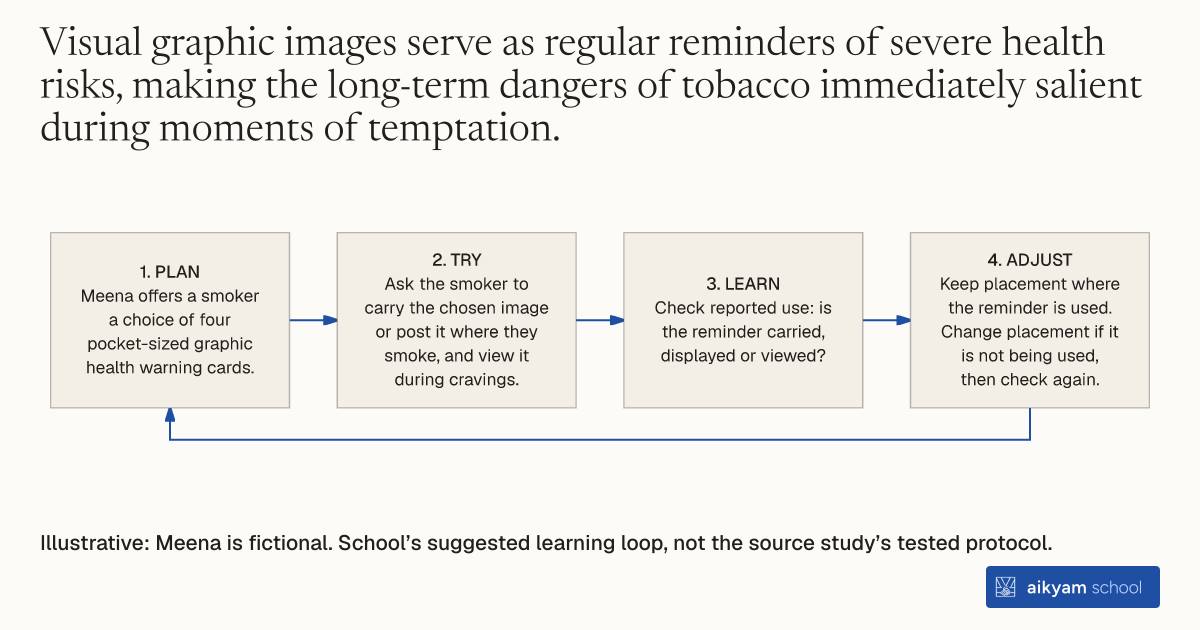
Try, learn and adjust
Check whether graphic reminders are used
- Plan: Meena offers a smoker a choice of four pocket-sized graphic health warning cards.
- Try: Ask the smoker to carry the chosen image or post it where they smoke, and view it during cravings.
- Learn: Check reported use: is the reminder carried, displayed or viewed?
- Adjust: Keep placement where the reminder is used. Change placement if it is not being used, then check again.
Illustrative: Meena is fictional. School’s suggested learning loop, not the source study’s tested protocol.
See source →School’s suggested learning loop checks use, separately from the cue-card trial. Offering cards had no statistically significant effect on 12-month test passage.
How
When to use
Smokers often experience sudden triggers and cravings that prompt relapse when visual cues are absent. Providing portable visual reminders of tobacco health hazards helps individuals manage momentary urges to smoke. This method offers public health programs a simple, low-cost behavioral tool to disrupt automatic smoking triggers in daily environments.
Distribute pocket-sized graphic warning cards and instruct smokers to keep them visible during craving triggers.
- Bank marketers offer regular smokers a choice among four graphic health cards depicting smoking damage.
- Marketers present cards showing a premature baby, diseased teeth and mouth cancer, black lungs, or a child on a respirator.
- Marketers instruct participants to carry the selected pocket-sized card in their wallets or pockets.
- Marketers encourage participants to post the cards in locations where they regularly smoke.
- Participants view the graphic images whenever they experience cravings or feel prompted to smoke.
Why it works
The pocket-sized format ensures that the visual warning is physically present whenever a smoker reaches for a cigarette.
Example
Green Bank marketers offered pocket-sized cue cards to smokers in Butuan City and Ampayon in the Philippines, with over 99 percent accepting a card, but only 6 percent reported actively using them after one year.
About the study
Participants
603 adult regular smokers assigned to the cue card group out of 2,000 participants in Mindanao, Philippines, averaging 36 years of age and 15 cigarettes per day.
Study Design
Randomized controlled trial comparing subjects offered graphic cue cards against control subjects receiving basic health literature and subjects offered commitment savings accounts.
Results
Offering cue cards produced no statistically significant effect on 12-month urine test passage rates, increasing passage by only an insignificant 0.5 to 1.9 percentage points over control group rates.