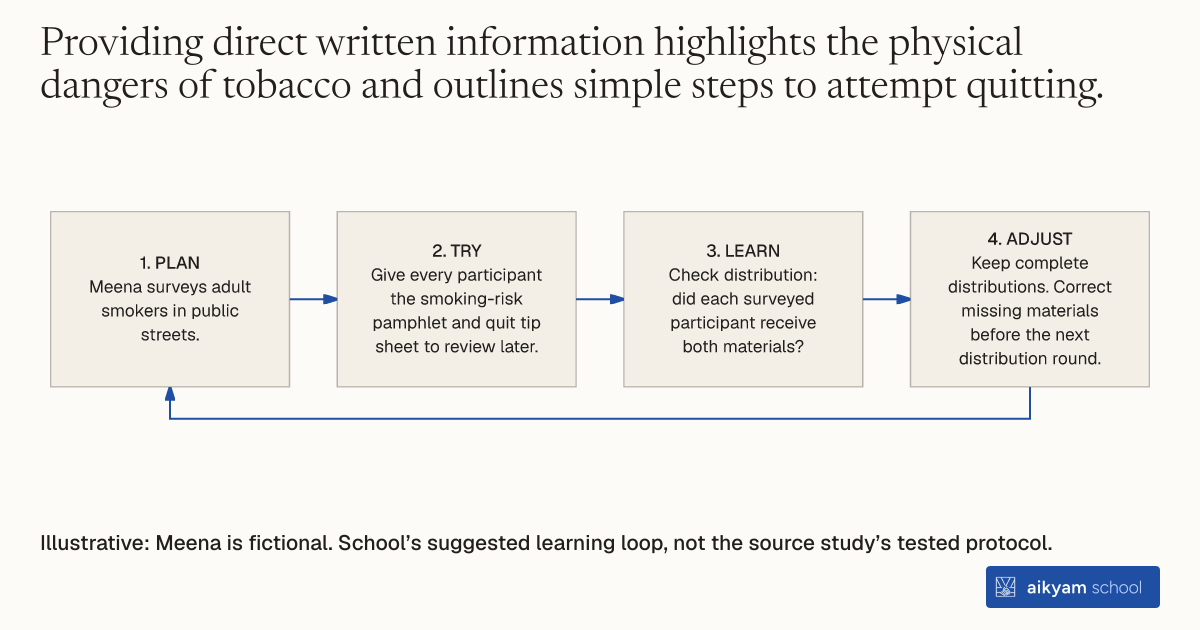
Try, learn and adjust
Check both smoking-information sheets are delivered
- Plan: Meena surveys adult smokers in public streets.
- Try: Give every participant the smoking-risk pamphlet and quit tip sheet to review later.
- Learn: Check distribution: did each surveyed participant receive both materials?
- Adjust: Keep complete distributions. Correct missing materials before the next distribution round.
Illustrative: Meena is fictional. School’s suggested learning loop, not the source study’s tested protocol.
See source →School’s suggested learning loop checks material delivery, separately from the study’s provision of literature to all subjects.
How
When to use
Many smokers lack clear information on tobacco risks and simple methods for quitting. Distributing health literature offers a low-cost, light-touch intervention for community health programs. It helps public health teams establish a baseline level of awareness before introducing stronger behavioral incentives.
Provide standard health literature and quitting guidance to smokers immediately after completing a baseline survey.
- Bank marketers identify adult smokers in public streets and conduct a baseline survey.
- Marketers hand an informational pamphlet on the dangers of smoking to each subject.
- Marketers give a tip sheet explaining specific steps to quit smoking to each subject.
- Marketers leave the materials with subjects to review at their own convenience.
Why it works
Written pamphlets ensure that every individual receives a consistent message about health risks regardless of location.
Example
Green Bank marketers provided informational pamphlets and quit tip sheets to 2,000 regular smokers in the Philippines. Among participants receiving only these materials, 8.9 percent to 14.7 percent passed a 12-month urine test for nicotine.
About the study
Participants
2,000 adult smokers aged 18 or older in Mindanao, Philippines, smoking an average of 14 cigarettes per day.
Study Design
Randomized controlled trial comparing subjects who received only health materials with subjects offered additional commitment savings accounts or cue cards.
Results
Subjects receiving only the pamphlets and tip sheets achieved 12-month urine test passage rates ranging between 8.9 percent and 14.7 percent depending on missing data assumptions.