Research steps
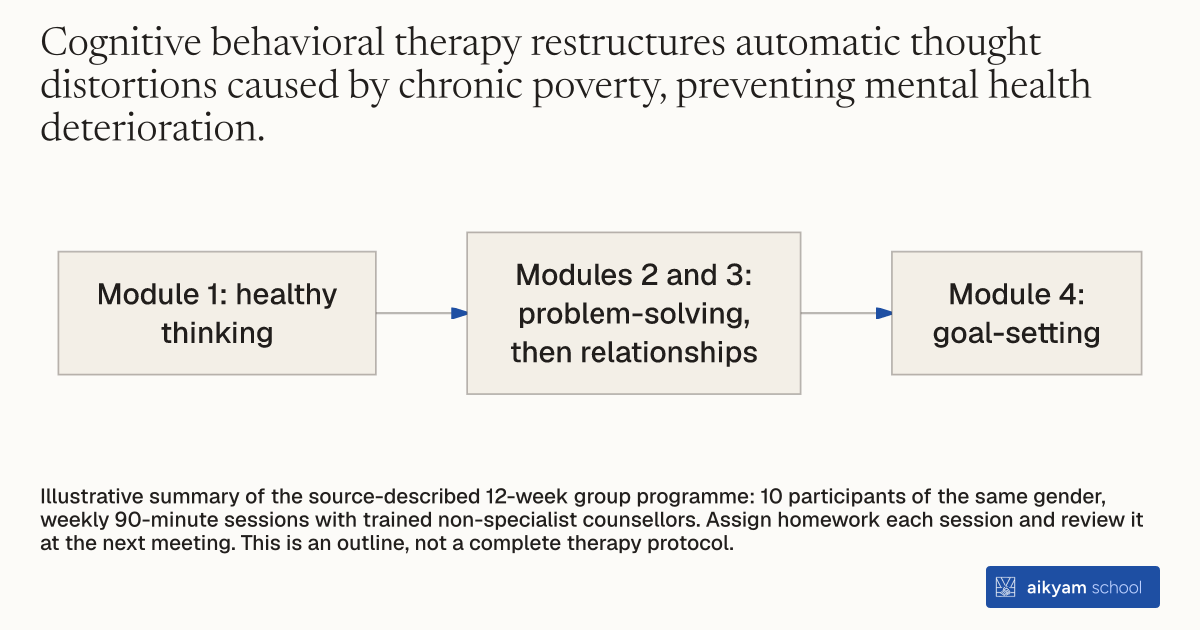
Follow the manual’s four therapy modules
- Module 1: healthy thinking
- Modules 2 and 3: problem-solving, then relationships
- Module 4: goal-setting
Illustrative summary of the source-described 12-week group programme: 10 participants of the same gender, weekly 90-minute sessions with trained non-specialist counsellors. Assign homework each session and review it at the next meeting. This is an outline, not a complete therapy protocol.
See source →How
When to use
Poor rural populations face persistent economic stressors and cognitive bandwidth scarcity that limit decision-making and well-being. Standard mental health programs often focus narrowly on diagnosed clinical conditions rather than general poverty alleviation. Deliver group therapy across an entire low-income population to increase mental health, socioemotional skills, and economic outlook.
Deliver a manualized 12-week group cognitive behavioral therapy program in local communities to strengthen decision-making bandwidth and psychological resilience.
- Group participants into community-based cohorts of 10 individuals of the same gender.
- Conduct weekly 90-minute sessions in local communities over 12 consecutive weeks, led by trained non-specialist counselors.
- Teach Module 1 on healthy thinking by training participants to identify and challenge automatic thought distortions.
- Deliver Module 2 on problem-solving at home and at work using the cognitive skills developed in Module 1.
- Facilitate Module 3 on managing relationships, covering interpersonal communication, self-esteem, and self-care.
- Complete Module 4 on goal-setting and goal-directed behavior.
- Assign practical homework tasks at the end of each session and review progress at the start of the next meeting.
Why it works
By evaluating thoughts objectively, participants reduce scarcity-induced tunneling and free up mental bandwidth for productive decision-making.
Example
Innovations for Poverty Action delivered the 12-week CBT program to randomized low-income households in 161 communities across Ghana. Counselors led 10-person group sessions covering the four manualized modules, assigning and reviewing weekly homework.
About the study
Participants
7,445 adults from poor households across 258 rural communities in 14 districts in Ghana.
Study Design
Individual and community-level randomized controlled trial evaluating 12 weekly group CBT sessions versus a control group, measuring outcomes 2–3 months post-intervention.
Results
Increased mental health index by 0.15 standard deviations, reduced K10 distress scores by 1.36 points, increased socioemotional skills by 0.27 standard deviations, increased cognitive index by 0.08 standard deviations, and improved downstream economic status by 0.19 standard deviations.