Research procedure
Describe the phone therapy schedule
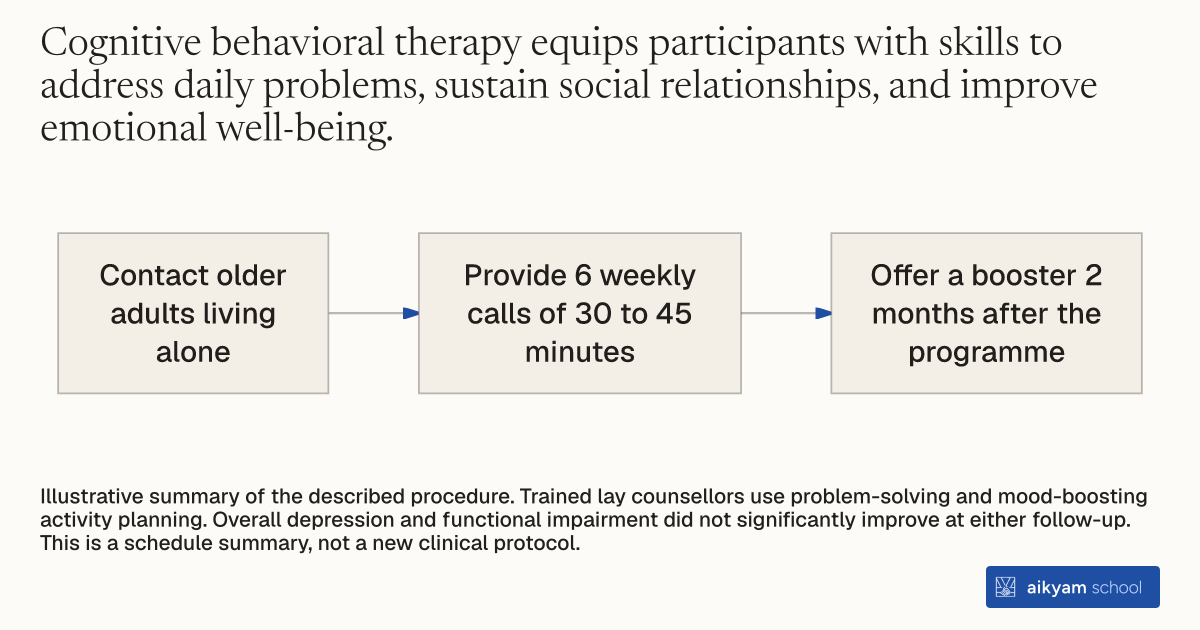
- Contact older adults living alone
- Provide 6 weekly calls of 30 to 45 minutes
- Offer a booster 2 months after the programme
Illustrative summary of the described procedure. Trained lay counsellors use problem-solving and mood-boosting activity planning. Overall depression and functional impairment did not significantly improve at either follow-up. This is a schedule summary, not a new clinical protocol.
See source →How
When to use
Older adults living alone face heightened risks of loneliness, depression, and mental health decline. Low- and middle-income regions often lack licensed therapists to provide in-person care. Remote talk therapy delivered by lay counselors provides an accessible mental health intervention for homebound seniors.
Deliver phone-based cognitive behavioral therapy to older adults through structured sessions led by trained lay counselors.
- Lay counselors contact selected older adults living alone by telephone.
- Counselors conduct weekly 30- to 45-minute phone calls over six consecutive weeks.
- Counselors guide participants to brainstorm solutions to everyday challenges.
- Counselors help participants identify and plan activities that boost their mood.
- Counselors offer an additional booster session two months after the weekly program ends.
Why it works
Delivering therapy over the phone via trained lay counselors expands access in resource-limited settings without licensed therapists.
Example
In Tamil Nadu, India, 377 older adults living alone participated in six weekly 30- to 45-minute phone therapy calls with trained lay counselors. The intervention cost US\$19 per person, and women in the program experienced a 3.5-point short-term reduction in functional impairment at three weeks.
About the study
Participants
1,120 low-income adults aged 55 or older living alone in Tamil Nadu, India, with 377 assigned to phone-based CBT (83 percent women, 77.1 percent widowed, average monthly spend INR 1,699).
Study Design
Randomized controlled trial assigning participants to phone-based CBT, cash transfers, both, or a comparison group across three waves in 2021, with outcomes assessed three weeks and three months post-treatment.
Results
Phone CBT did not significantly reduce depression scores or overall functional impairment relative to the comparison group at three weeks or three months, though women showed a short-term functional impairment decrease of 3.5 points at three weeks.