Try, learn and adjust
Check counsellor preparation and weekly support
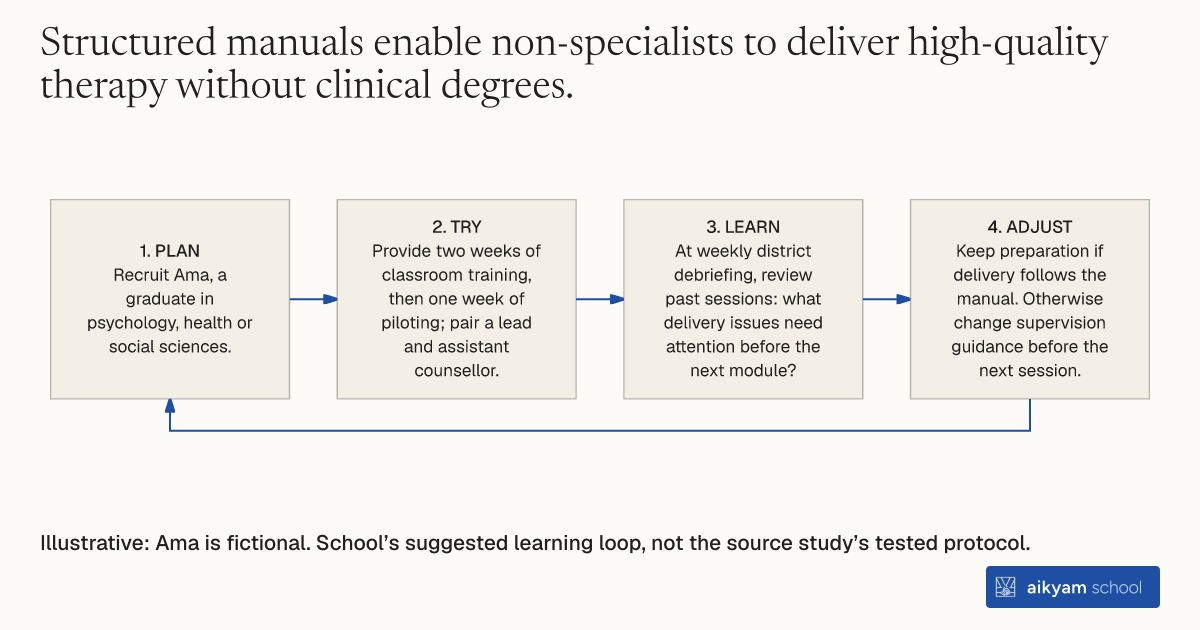
- Plan: Recruit Ama, a graduate in psychology, health or social sciences.
- Try: Provide two weeks of classroom training, then one week of piloting; pair a lead and assistant counsellor.
- Learn: At weekly district debriefing, review past sessions: what delivery issues need attention before the next module?
- Adjust: Keep preparation if delivery follows the manual. Otherwise change supervision guidance before the next session.
Illustrative: Ama is fictional. School’s suggested learning loop, not the source study’s tested protocol.
See source →School’s suggested, untested learning loop. Observe training, piloting and weekly debriefing issues. This is a staff-support check, not a clinical protocol.
How
When to use
Poor rural communities often face severe shortages of clinical mental health professionals. Organizations need a practical way to deliver structured therapy using non-specialist staff. This method helps health programs expand mental health support to impoverished populations in low-resource settings.
Train and supervise non-specialist tertiary graduates to deliver manualized group therapy through structured weekly debriefings.
- Hire recent university graduates with degrees in psychology, health, or social sciences.
- Provide all hired staff with two weeks of classroom training on the session manual.
- Require counselors to complete one week of practical field piloting before starting sessions.
- Assign staff into pairs consisting of one lead counselor and one assistant counselor.
- Hold weekly district debriefing meetings led by a lead counselor to review past sessions and prepare for upcoming modules.
Why it works
Weekly supervisory meetings maintain treatment quality and provide continuous guidance to counselors.
Example
Innovations for Poverty Action hired 37 non-specialist staff with bachelor's degrees across 14 districts in Ghana. The team completed two weeks of training and one week of piloting before leading 12-week group sessions under weekly supervision.
About the study
Participants
7,445 adults from poor households across 258 rural communities in Ghana.
Study Design
Randomized controlled trial comparing individuals assigned to 12 weekly group therapy sessions with control individuals across pure control and program communities.
Results
Non-specialist counselors achieved a 0.15 standard deviation increase in mental health, reduced K10 distress scores by 1.36 points, and increased socioemotional skills by 0.27 standard deviations.