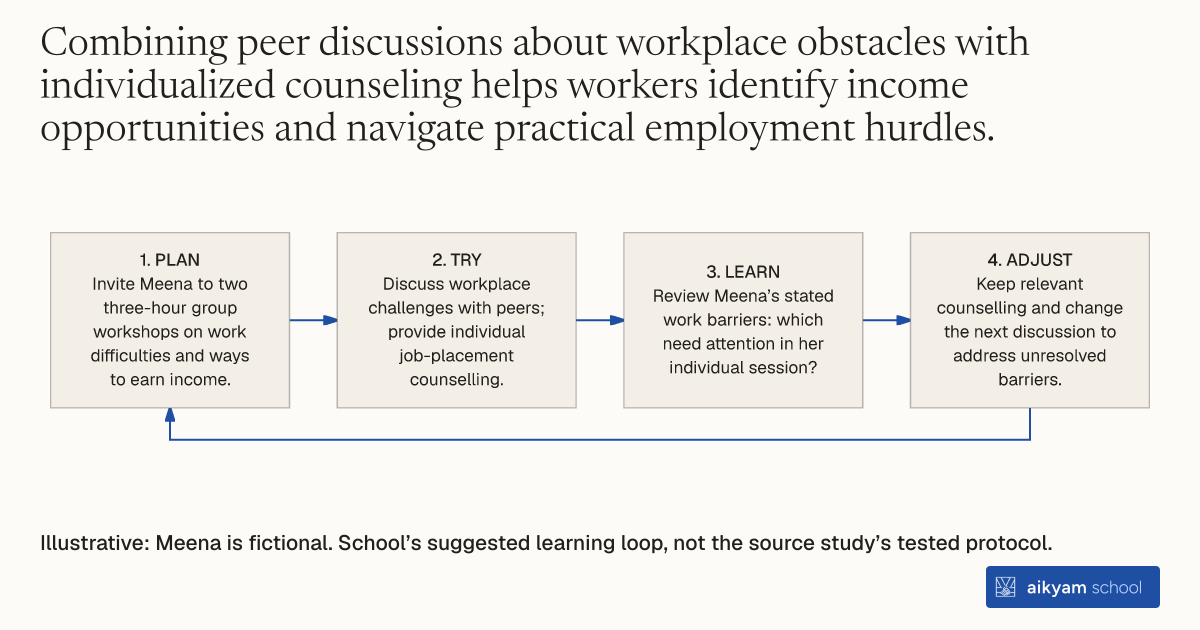
Try, learn and adjust
Use work challenges to guide job counselling
- Plan: Invite Meena to two three-hour group workshops on work difficulties and ways to earn income.
- Try: Discuss workplace challenges with peers; provide individual job-placement counselling.
- Learn: Review Meena’s stated work barriers: which need attention in her individual session?
- Adjust: Keep relevant counselling and change the next discussion to address unresolved barriers.
Illustrative: Meena is fictional. School’s suggested learning loop, not the source study’s tested protocol.
See source →School’s suggested, untested loop. Observe discussed barriers and job support; standalone assistance showed no significant work-time or earnings increase.
How
When to use
In low-income communities, adults with depression face major workplace challenges and barriers to increasing earnings. Providing standalone livelihoods assistance aims to help participants manage job-related challenges and identify ways to generate income.
Deliver group workshops and individual counseling to help adults with mild or moderate depression navigate work challenges and find employment opportunities.
- NGO staff organize two three-hour group meetings for program participants.
- Facilitators lead group discussions addressing workplace challenges and strategies to earn income.
- Participants discuss techniques to manage on-the-job difficulties with peers.
- Program staff schedule personalized one-on-one sessions with each participant.
- Counselors provide tailored job placement support during individual sessions.
Example
GASS staff delivered two three-hour group meetings and individual job placement counseling to 205 adults with mild or moderate depression across peri-urban villages near Bangalore, India.
About the study
Participants
205 adults with mild or moderate depression symptoms (86 percent women) in peri-urban villages near Bangalore, India.
Study Design
Randomized controlled trial evaluating a standalone livelihoods assistance program featuring two three-hour group workshops and individual job placement sessions evaluated over 26 months across five survey waves.
Results
Standalone livelihoods assistance produced no statistically significant increase in work time or earnings, and did not reduce long-term depression severity compared to the comparison group.