Try, learn and adjust
Check payments reward sustained job matches
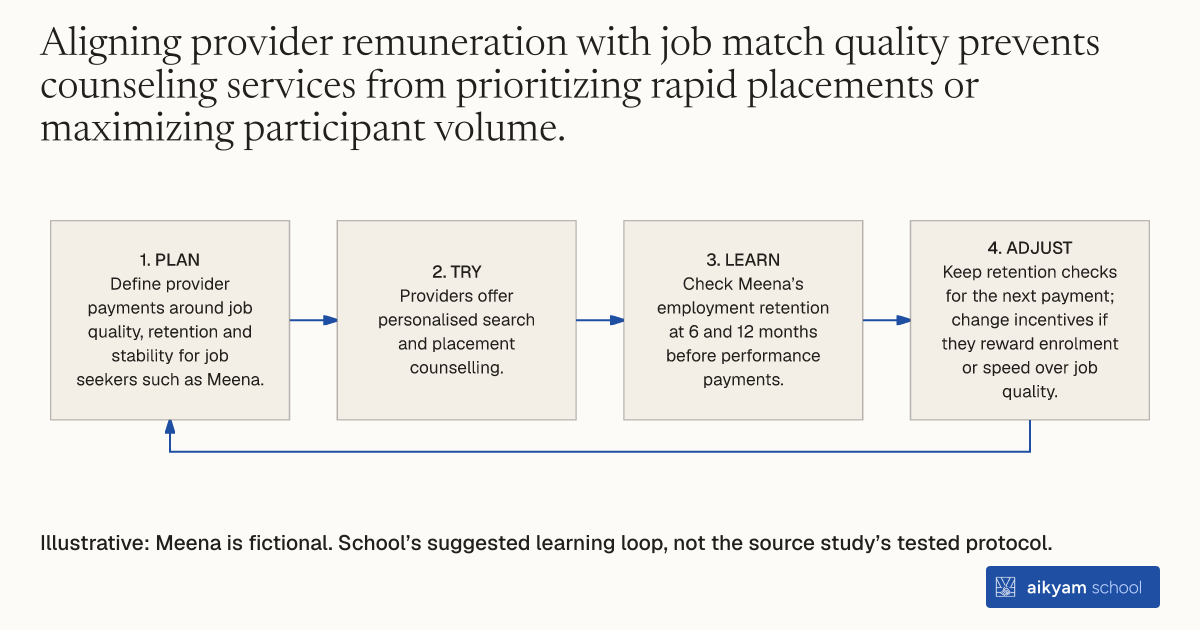
- Plan: Define provider payments around job quality, retention and stability for job seekers such as Meena.
- Try: Providers offer personalised search and placement counselling.
- Learn: Check Meena’s employment retention at 6 and 12 months before performance payments.
- Adjust: Keep retention checks for the next payment; change incentives if they reward enrolment or speed over job quality.
Illustrative: Meena is fictional. School’s suggested learning loop, not the source study’s tested protocol.
See source →School’s suggested, untested loop. Observe retention at 6 and 12 months and payment incentives.
How
When to use
Public employment agencies often outsource job search counseling to private providers to help long-term unemployed individuals. However, payment structures that compensate providers based on participant volume or rapid placement cause sub-optimal job matching. Designing performance-based provider contracts helps align private counselor incentives with long-term employment quality and participant fit.
Structure payment contracts for private job search counseling providers to link remuneration to sustainable employment quality indicators rather than participant volume alone.
- Public employment service managers draft procurement contracts for external counseling providers.
- Contracting officers define performance metrics linked to job match quality, post-placement retention, and employment stability.
- Program managers structure financial payment tiers that reward providers for sustainable long-term placements rather than high enrollment volume or rapid short-term placements.
- Private counseling providers deliver personalized job search assistance and placement counseling to assigned participants.
- Contract administrators monitor participant employment retention at 6-month and 12-month intervals to disburse performance payments.
Why it works
This ensures counselors allocate job seekers to suitable employment opportunities that yield sustained long-term benefits.
Example
In France, private counseling providers for people at risk of long-term unemployment were less effective at increasing employability because their payment structure encouraged maximizing participant enrollment rather than finding suitable job matches. In Switzerland, private providers for workers unemployed for one year generated better short-term employment, but worse long-term employment because payments incentivized faster placement over placement quality.
Source
See source →Evidence in Labor Market Policies and Implications for Brazil: Job Search Assistance
Copyright © 2023 Inter-American Development Bank.
Full source notice
Copyright © 2023 Inter-American Development Bank ("IDB"). This work is subject to a Creative Commons license CC BY 3.0 IGO (https://creativecommons.org/licenses/by/3.0/igo/legalcode). The terms and conditions indicated in the URL link must be met and the respective recognition must be granted to the IDB. Further to section 8 of the above license, any mediation relating to disputes arising under such license shall be conducted in accordance with the WIPO Mediation Rules. Any dispute related to the use of the works of the IDB that cannot be settled amicably shall be submitted to arbitration pursuant to the United Nations Commission on International Trade Law (UNCITRAL) rules. The use of the IDB's name for any purpose other than for attribution, and the use of IDB's logo shall be subject to a separate written license agreement between the IDB and the user and is not authorized as part of this license. Note that the URL link includes terms and conditions that are an integral part of this license.