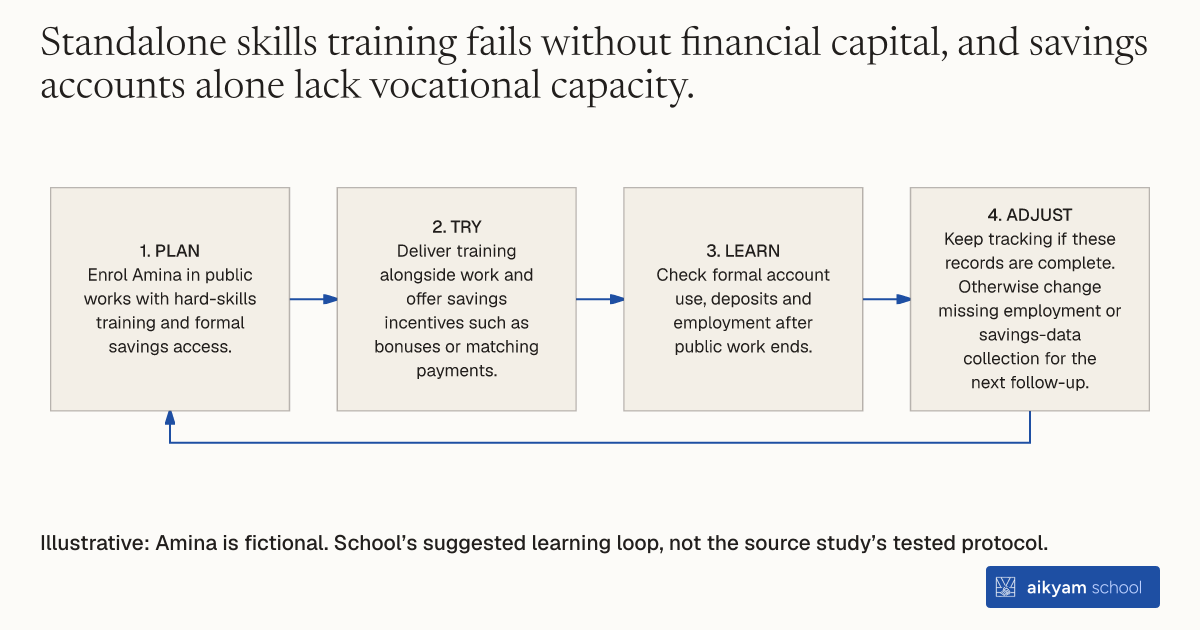
Try, learn and adjust
Check delivery of skills and savings support
- Plan: Enrol Amina in public works with hard-skills training and formal savings access.
- Try: Deliver training alongside work and offer savings incentives such as bonuses or matching payments.
- Learn: Check formal account use, deposits and employment after public work ends.
- Adjust: Keep tracking if these records are complete. Otherwise change missing employment or savings-data collection for the next follow-up.
Illustrative: Amina is fictional. School’s suggested learning loop, not the source study’s tested protocol.
See source →School’s suggested learning loop: observe training, savings and subsequent employment. The evaluated package combines training with incentivised savings; this loop does not isolate either component’s effect.
How
When to use
Low-income public works participants facing low employment and poor savings retention after temporary job programs end. Address the failure of standalone vocational training to generate long-term labor market benefits or capital accumulation. Provide public works participants in fragile or low-income settings with lasting skills and formal financial tools.
Combine hard-skills vocational training with formal savings incentives for public works participants.
- Enroll public works participants into government-sponsored cash-for-work infrastructure projects.
- Deliver structured hard-skills vocational training courses during or alongside active employment project deployment.
- Provide participants with access to formal bank accounts or formal savings channels.
- Supply financial incentives, such as bonuses or matching schemes, to encourage account usage and savings deposits.
- Transition participants out of active public workfare into market employment or self-employment with accumulated savings.
Why it works
Combining hard skills with incentivized savings gives workers both the capability and the capital to secure jobs or invest in productive activities.
Example
In the Democratic Republic of the Congo, public works participants provided with hard-skills training and an incentivized savings scheme experienced the largest positive impacts on job likelihood and total savings compared to participants receiving only skills training.
About the study
Participants
Public works participants in the Democratic Republic of the Congo.
Study Design
Randomized controlled trial evaluating standalone workfare, workfare with skills training, and workfare with skills training plus incentivized formal savings.
Results
Participants receiving hard-skills training bundled with incentivized formal savings experienced the largest positive impacts on job likelihood and total savings, whereas participants receiving skills training alone saw no positive effects.