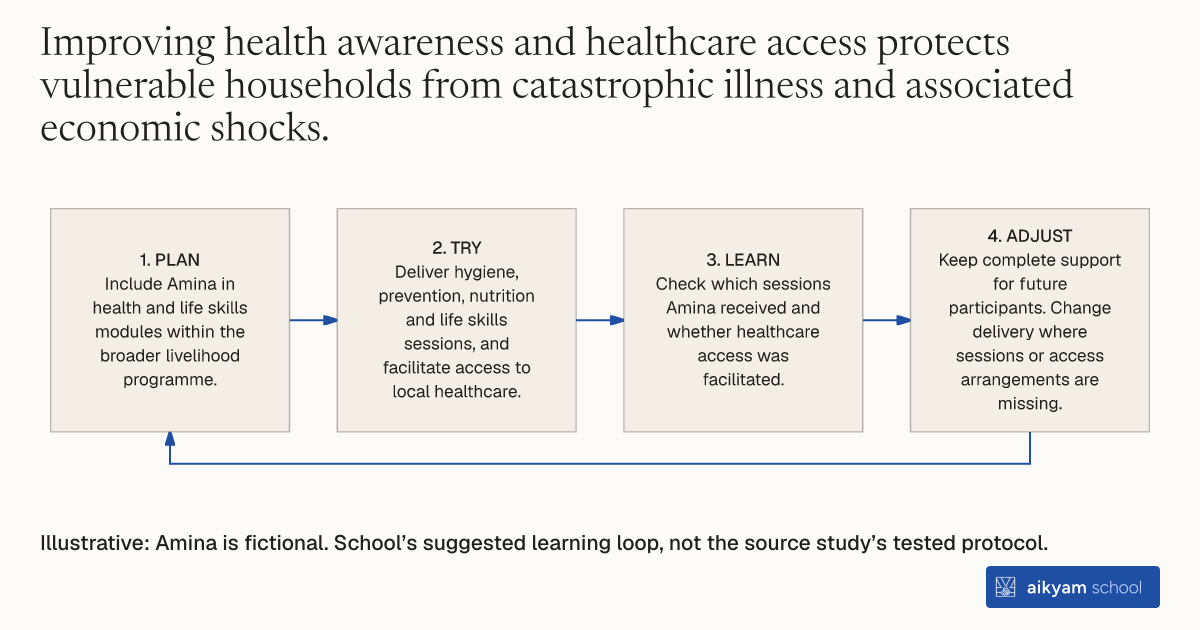
Try, learn and adjust
Check health and life skills support is delivered
- Plan: Include Amina in health and life skills modules within the broader livelihood programme.
- Try: Deliver hygiene, prevention, nutrition and life skills sessions, and facilitate access to local healthcare.
- Learn: Check which sessions Amina received and whether healthcare access was facilitated.
- Adjust: Keep complete support for future participants. Change delivery where sessions or access arrangements are missing.
Illustrative: Amina is fictional. School’s suggested learning loop, not the source study’s tested protocol.
See source →School’s suggested, untested loop. Observe education, life skills provision and healthcare access. This is not a clinical protocol or proof of component-level health effects.
How
When to use
Extreme poverty subjects ultra-poor households to frequent health shocks and limited personal empowerment, compounding economic precarity. Poor health and a lack of social life skills impede families from engaging productively in basic livelihoods or maintaining physical well-being. Provide health education, healthcare access, and life skills training to protect human capital and foster personal empowerment.
Deliver health education, healthcare services, and life skills training to ultra-poor program participants.
- Program managers include health and life skills modules in the broader livelihood intervention design.
- Field staff deliver health education sessions on hygiene, preventative care, and basic nutrition.
- Facilitators conduct life skills training to improve social confidence, decision-making, and communication.
- Program officers facilitate participant access to local healthcare providers or medical services.
Why it works
Developing core life skills builds personal confidence, supporting broader socio-economic participation and long-term well-being.
Example
In a multi-country review of twenty randomized evaluations, health components embedded within Graduation programs contributed to sustained improvements in physical health, psychological well-being, and economic stability across diverse sites.