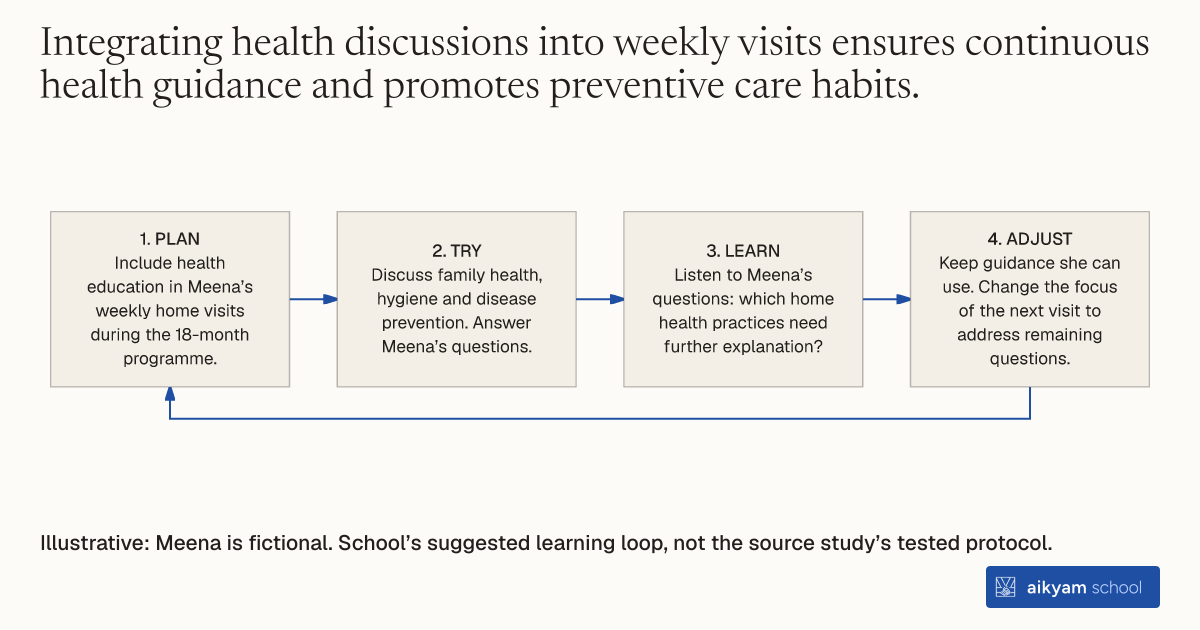
Try, learn and adjust
Use household questions to guide health discussions
- Plan: Include health education in Meena’s weekly home visits during the 18-month programme.
- Try: Discuss family health, hygiene and disease prevention. Answer Meena’s questions.
- Learn: Listen to Meena’s questions: which home health practices need further explanation?
- Adjust: Keep guidance she can use. Change the focus of the next visit to address remaining questions.
Illustrative: Meena is fictional. School’s suggested learning loop, not the source study’s tested protocol.
See source →School’s suggested, untested loop. Observe health questions and discussed practices; this does not isolate health education from the wider programme.
How
When to use
Extremely poor rural households suffer from poor health and low health awareness, which undermines work productivity and household stability. Families living in extreme poverty often lack basic health knowledge and access to health information. Program managers deliver health education during routine coaching visits to improve participant physical and mental well-being.
Discuss health matters with participants during weekly home visits throughout the program period.
- Schedule regular weekly home visits conducted by organization staff for each participating household.
- Incorporate structured health education discussions into the routine weekly visit.
- Provide practical guidance on family health, hygiene, and disease prevention.
- Answer participant health queries and reinforce healthy home practices over the 18-month program duration.
Why it works
Improved physical and mental health protects household labor productivity and reinforces overall program gains.
Example
In West Bengal, India, Bandhan staff conducted weekly discussions on health matters with 514 ultra-poor households during routine home visits over an 18-month period. Adults in participating households experienced sustained improvements in physical and mental health measures immediately following the program and seven to ten years later.
About the study
Participants
978 ultra-poor households in Murshidabad, West Bengal, India, consuming 40 US dollars per month on average.
Study Design
Randomized controlled trial comparing 514 treatment households receiving the 18-month Graduation package against 464 comparison households tracked across ten years.
Results
Measures of physical health and mental health improved among adults in Graduation households immediately upon program completion, as well as seven and ten years following the asset transfer.