Try, learn and adjust
Check ad impressions within the spending limit
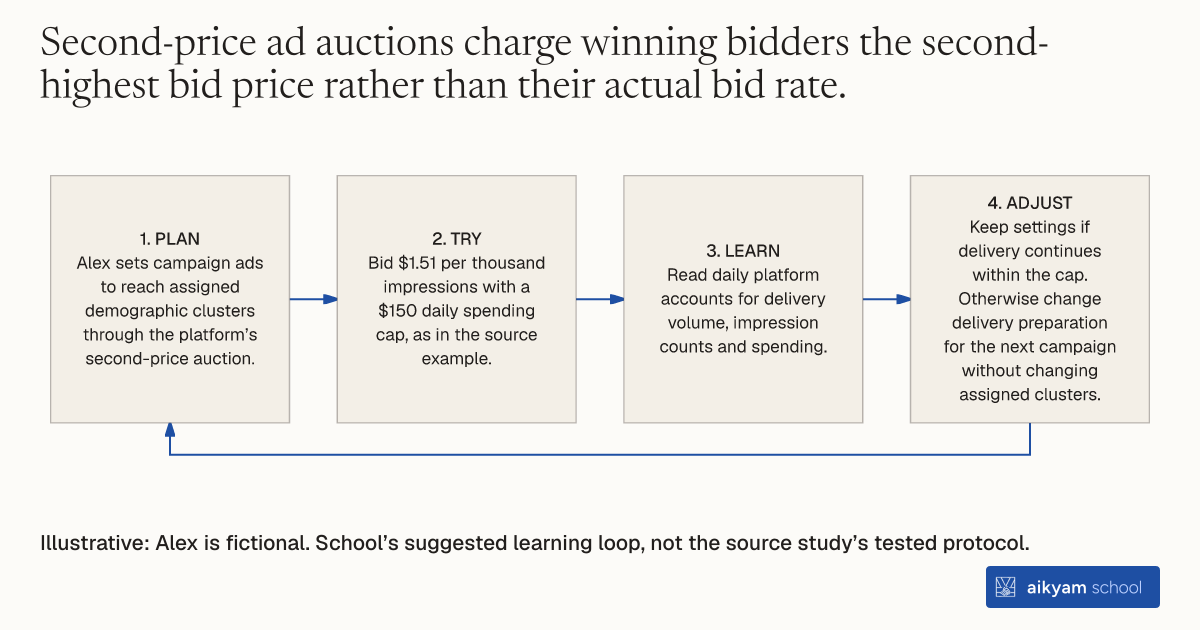
- Plan: Alex sets campaign ads to reach assigned demographic clusters through the platform’s second-price auction.
- Try: Bid $1.51 per thousand impressions with a $150 daily spending cap, as in the source example.
- Learn: Read daily platform accounts for delivery volume, impression counts and spending.
- Adjust: Keep settings if delivery continues within the cap. Otherwise change delivery preparation for the next campaign without changing assigned clusters.
Illustrative: Alex is fictional. School’s suggested learning loop, not the source study’s tested protocol.
See source →Observe daily impressions and spending. High delivery volume does not establish changes in candidate views. School’s suggested learning loop; not a tested source procedure.
How
When to use
Political campaigns or researchers want to deliver the maximum possible volume of online display advertisements to a targeted audience. Standard ad platform mini-auctions restrict ad delivery when bids are set near average market clearing rates. Submitting exceptionally high bids in second-price auctions solves this problem by guaranteeing maximum ad delivery saturation without overpaying per impression.
Submit campaign advertisement bids far above market clearing prices in second-price ad auctions to maximize impression frequency to targeted groups.
- Design standard digital display advertisements tailored to targeted campaign messages.
- Configure targeting parameters on the advertising platform to deliver ads exclusively to selected demographic clusters.
- Determine the baseline market clearing price for impressions on the platform, typically under \$0.30 per thousand impressions.
- Set the ad bid rate at a high multiple of the market price, such as \$1.51 per thousand impressions, while capping the daily spending budget at \$150.
- Serve the advertisements through the platform auction system across a weeklong campaign period.
- Monitor daily ad delivery volume and impression counts using the platform accounting interface.
Why it works
High bids guarantee winning virtually every available auction for the targeted audience while market clearing dynamics keep actual costs low.
Example
In Study 1, a Republican state legislative campaign in a rural district placed a bid of \$1.51 per thousand impressions—five times the market clearing price under \$0.30—with a daily spending budget of \$150. Over five days, Facebook delivered 14,734 users an average of 36 ad impressions each, spending \$40 per day due to finite constituency log-ins.
About the study
Participants
14,734 targeted Facebook users out of 32,029 registered voters aged 30 to 75 in 34 towns for Study 1, and 108,783 targeted users in Study 2.
Study Design
Clustered randomized field experiment deploying high-bid Facebook display ads over five to seven days, followed by telephone polling.
Results
Ad delivery reached an average of 36.6 impressions per user in Study 2, but produced a non-significant -1.1 percentage point change in candidate name recognition (95% CI [-0.041, 0.018]) and a 0.8 percentage point change in favorability (95% CI [-0.017, 0.034]).