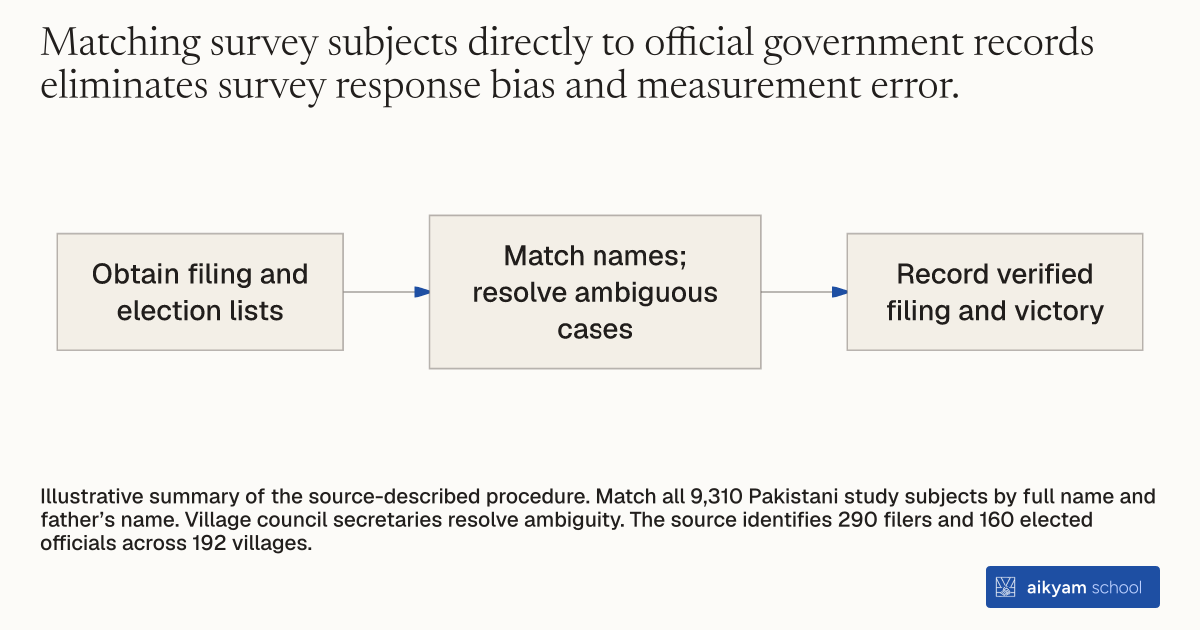
Research steps
Verify candidacy in official records
- Obtain filing and election lists
- Match names; resolve ambiguous cases
- Record verified filing and victory
Illustrative summary of the source-described procedure. Match all 9,310 Pakistani study subjects by full name and father’s name. Village council secretaries resolve ambiguity. The source identifies 290 filers and 160 elected officials across 192 villages.
See source →How
When to use
Self-reported candidate filing and election results in political surveys suffer from social desirability bias and memory errors. Researchers need an objective method to determine whether experimental subjects actually filed candidacy papers or won office. Linking survey participants to official election commission records verifies political outcomes directly.
Match survey participants to official candidate lists and election returns from government authorities.
- Obtain official lists of candidate filings and elected representatives from district offices of the Election Commission.
- Match survey respondents from the experimental sample to official candidate lists using full name and father's name.
- Identify ambiguous matches where multiple individuals share identical names in the same locality.
- Contact local village council secretaries to resolve ambiguous matches using official administrative records.
- Record binary indicator variables for candidacy filing and election victory for each verified subject.
Why it works
Verified electoral data allow researchers to measure actual political behavior instead of self-reported intentions.
Example
In Haripur and Abbottabad districts of Pakistan, researchers matched 9,310 sampled citizens to official candidate and election lists released by the Election Commission of Pakistan. Using name and father's name matching backed by local bureaucrat verification, the team verified that 290 sampled individuals filed candidacy papers and 160 won office across 192 villages.
About the study
Participants
9,310 male citizens across 192 villages in Haripur and Abbottabad districts, Khyber Pakhtunkhwa province, Pakistan.
Study Design
Record linkage matching experimental survey subjects to official administrative ballot and election result records from the Election Commission of Pakistan, using local council secretaries to resolve ambiguous matches.
Results
Record matching identified 290 candidate filers and 160 elected officials among the 9,310 subjects; social versus personal messaging increased verified candidacy by 1.8 percentage points (p = 0.007) and verified election by 1.2 percentage points (p = 0.006).