Research groups
Compare payment schedules
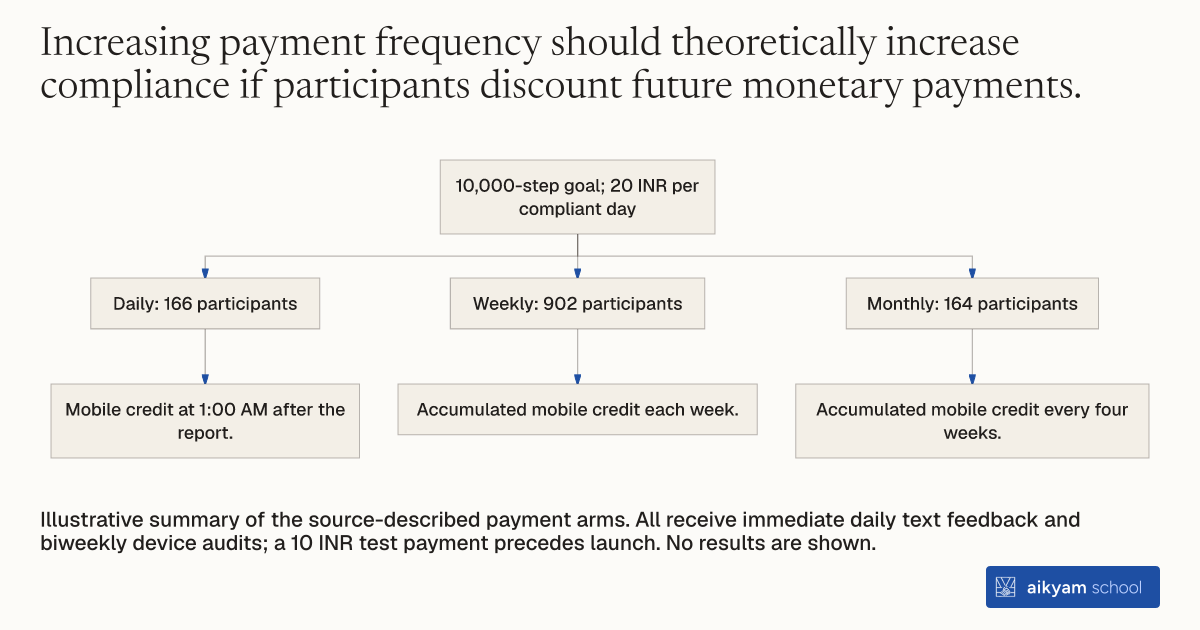
10,000-step goal; 20 INR per compliant day
- Daily: 166 participants
- Mobile credit at 1:00 AM after the report.
- Weekly: 902 participants
- Accumulated mobile credit each week.
- Monthly: 164 participants
- Accumulated mobile credit every four weeks.
Illustrative summary of the source-described payment arms. All receive immediate daily text feedback and biweekly device audits; a 10 INR test payment precedes launch. No results are shown.
See source →How
When to use
Behavioral programs often test whether delivering financial rewards immediately after task completion increases performance by reducing payment discounting. However, when target populations exhibit high patience over money or when automated feedback already provides real-time information, higher payment frequency may not improve task compliance. This method evaluates daily versus weekly or monthly mobile credit recharge schedules for adults tracking daily physical activity.
Deliver linear financial incentives for tracked daily exercise targets using varied payout schedules to evaluate payment frequency effects.
- Assign participants a fixed daily exercise goal of 10,000 steps monitored via pedometers.
- Provide immediate daily confirmation text messages following evening step reports to maintain feedback salience across all payment arms.
- Distribute a small test payment of 10 INR the night before program launch to establish trust in the payment system.
- Transfer financial rewards of 20 INR per compliant day directly to participants' prepaid mobile accounts at assigned frequencies: daily at 1:00 AM, weekly, or monthly every four weeks.
- Maintain consistent daily step feedback and biweekly field worker pedometer audits regardless of payment frequency schedule.
Why it works
However, when individuals exhibit low discount rates over financial payments and receive immediate daily feedback, altering payment schedules yields no additional exercise effort.
Example
Surveyors randomized 166 participants into daily payment, 902 into weekly payment, and 164 into monthly payment groups among adults with diabetes or high blood sugar in Coimbatore, India. Daily payment resulted in a 20.1 percentage point increase in step-target compliance over monitoring, which was statistically indistinguishable from weekly at 21.1 percentage points or monthly at 17.7 percentage points.
About the study
Participants
1,232 participants across frequency arms (166 in Daily, 902 in Base Case weekly, 164 in Monthly) in Coimbatore, India, with an average age of 49.56 years, 42 percent female, 67 percent diagnosed diabetic, and an average monthly per capita income of 4,465 INR.
Study Design
A randomized evaluation comparing daily (1:00 AM night of report), weekly, and monthly linear mobile credit recharge delivery of 20 INR per 10,000-step day across a 12-week intervention period.
Results
Daily payments increased step-target compliance by 20.1 percentage points relative to monitoring, showing no significant difference compared to weekly (21.1 percentage points, p=0.710) or monthly (17.7 percentage points, p=0.180) payments.