Try, learn and adjust
Check the monthly walking reward total
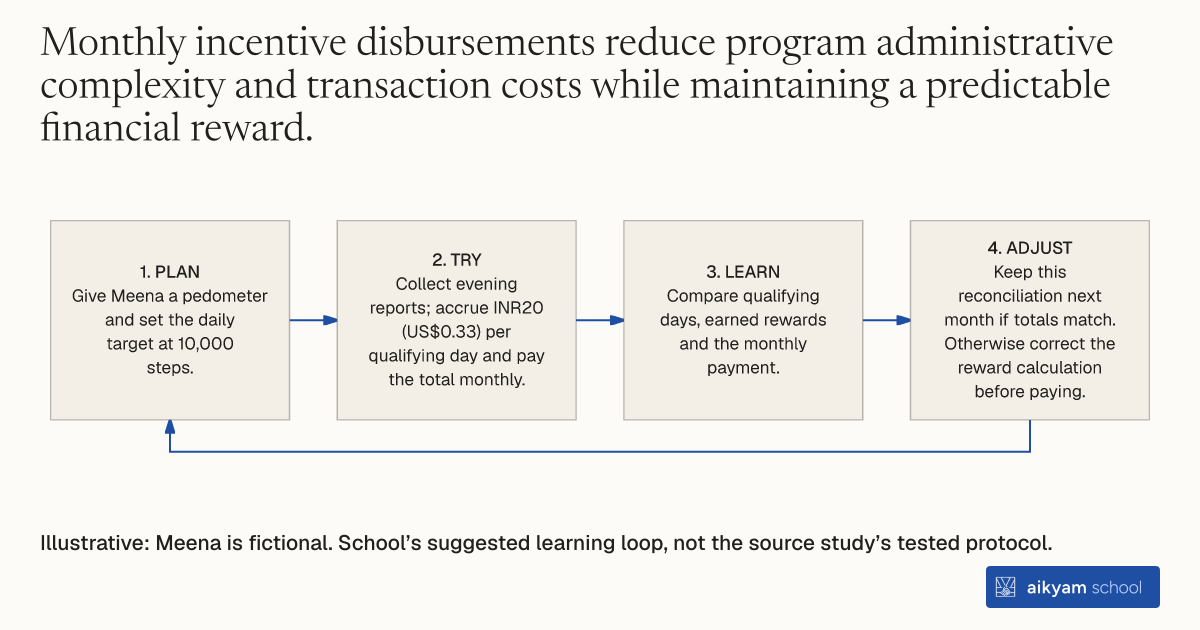
- Plan: Give Meena a pedometer and set the daily target at 10,000 steps.
- Try: Collect evening reports; accrue INR20 (US$0.33) per qualifying day and pay the total monthly.
- Learn: Compare qualifying days, earned rewards and the monthly payment.
- Adjust: Keep this reconciliation next month if totals match. Otherwise correct the reward calculation before paying.
Illustrative: Meena is fictional. School’s suggested learning loop, not the source study’s tested protocol.
See source →School’s suggested, untested learning loop. Observe daily targets and monthly payments. Over twelve weeks, monthly compliance did not differ significantly from daily or weekly payment.
How
When to use
Many diabetic and prediabetic adults find daily physical exercise challenging due to immediate effort costs. Health programs often consider consolidating financial rewards into monthly disbursements to simplify administration and logistics. Providing monthly incentive payments tests whether lower disbursement frequency maintains compliance compared to daily or weekly payments.
Disburse accumulated financial rewards to participants once a month for each day they achieve their daily exercise goal.
- Distribute pedometers to program participants to monitor their daily physical activity.
- Establish a daily target of 10,000 steps for every participant.
- Require participants to record and report their step counts every evening using an automated phone system.
- Calculate earned rewards of INR20 (US\$0.33) for each day the participant met the 10,000-step goal over the past month.
- Pay the total accumulated financial reward to participants at the end of each month.
Why it works
Combining daily step tracking with monthly payouts maintains goal focus without requiring frequent payment processing.
Example
In Coimbatore, India, participants in the monthly payment contract received INR20 (US\$0.33) per day for all days they met their 10,000-step target over the past month, achieving a 47 percent target compliance rate over twelve weeks.
About the study
Participants
3,192 adults in Coimbatore, India, averaging 49 years old, where 67 percent had doctor-diagnosed diabetes, 82 percent had elevated HbA1c, 49 percent had hypertension, and 61 percent had obesity.
Study Design
A randomized controlled trial evaluating physical activity incentives and step-monitoring contracts among recruited adults across eight intervention and comparison groups over twelve weeks.
Results
Monthly incentive payments achieved a 47 percent target compliance rate, showing no significant difference compared to daily (51 percent) or weekly (49 percent) payment schedules, demonstrating that payment frequency did not impact total steps walked.