Research procedure
Track outcomes with longer recall
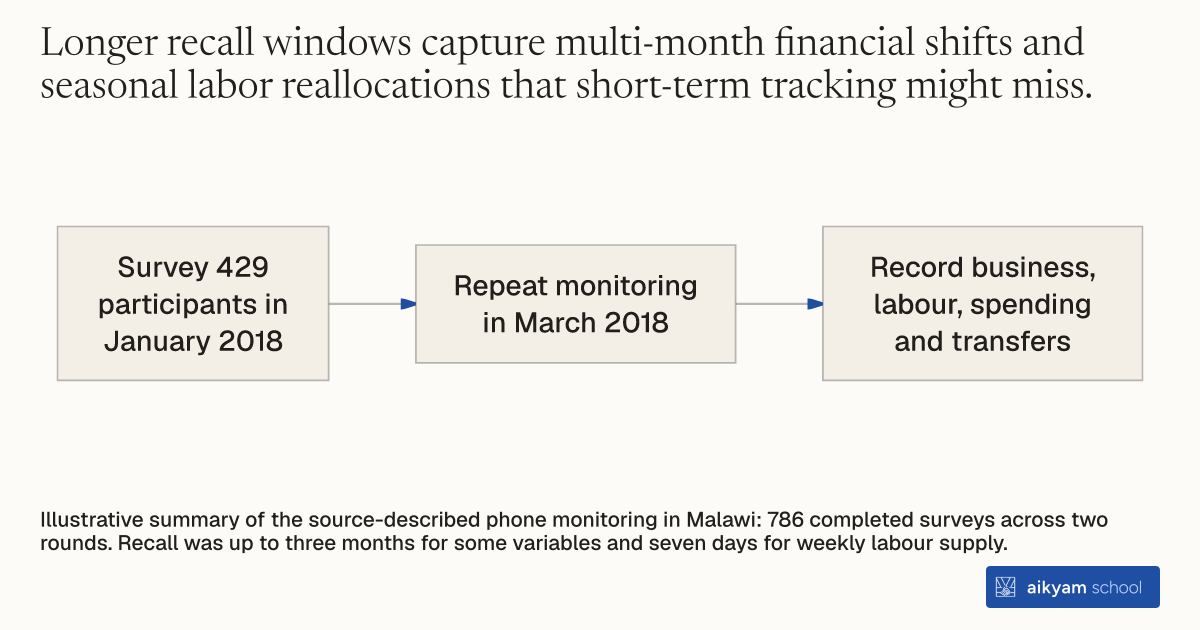
- Survey 429 participants in January 2018
- Repeat monitoring in March 2018
- Record business, labour, spending and transfers
Illustrative summary of the source-described phone monitoring in Malawi: 786 completed surveys across two rounds. Recall was up to three months for some variables and seven days for weekly labour supply.
See source →How
When to use
In longitudinal evaluations, program managers need to track medium-term economic outcomes across entire study samples. Frequent daily surveys create fatigue and cannot easily capture lower-frequency behaviors like multi-month expenditures or seasonal farming changes. Periodic monitoring surveys using longer recall windows collect broader impact metrics across the full participant sample while managing survey burden.
Administer periodic phone surveys covering longer recall windows to measure economic outcomes across the full participant cohort.
- Enumerators include all 429 study microentrepreneurs in the monitoring survey cohort.
- Conduct the first monitoring survey round via phone in January 2018.
- Conduct the second monitoring survey round via phone in March 2018.
- Set survey recall periods up to 3 months for lower-frequency economic variables and 7 days for weekly labor supply.
- Record outcomes on primary business hours, agricultural labor, total daily expenditures, and interpersonal transfer values.
Why it works
Surveying the full participant cohort provides statistical power to detect treatment effects across business and agricultural activities.
Example
Enumerators conducted two rounds of phone monitoring surveys in January and March 2018 across 429 microentrepreneurs in Blantyre, Malawi, capturing 786 completed surveys and revealing a 1.02 hour per week increase in farming labor.
About the study
Participants
429 microentrepreneurs in Blantyre, Malawi.
Study Design
Randomized controlled trial executing 2 rounds of phone-based monitoring surveys (January and March 2018) with 786 completed survey responses.
Results
Monitoring surveys showed mobile money provision reduced primary business labor by 0.62 hours per week (p < 0.10), increased farming labor by 1.02 hours per week (p < 0.10), and increased total daily expenditures by \$0.64 (p < 0.10).