Research procedure
Classify candidate strongholds
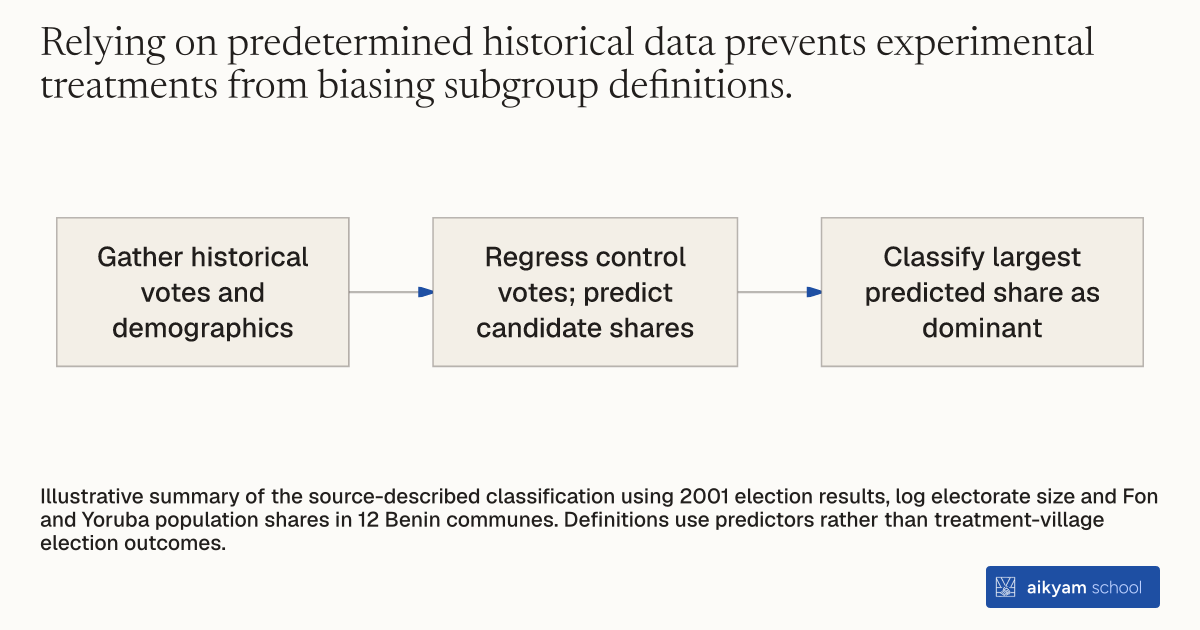
- Gather historical votes and demographics
- Regress control votes; predict candidate shares
- Classify largest predicted share as dominant
Illustrative summary of the source-described classification using 2001 election results, log electorate size and Fon and Yoruba population shares in 12 Benin communes. Definitions use predictors rather than treatment-village election outcomes.
See source →How
When to use
Evaluating campaign strategies requires distinguishing between areas where candidates enjoy political dominance and areas where they face competition. Defining candidate strongholds with post-treatment vote data introduces sample selection bias into subgroup analyses. Classifying strongholds with historical election results and demographic predictors creates exogenous subsamples for evaluating campaign effects.
Classify study regions into candidate strongholds using historical electoral outcomes and demographic predictors.
- Gather commune-level vote shares for leading candidates from the previous national presidential election.
- Calculate log electorate size and ethnic population shares across all study communes.
- Regress control group candidate vote shares on historical election results, log electorate size, and ethnic shares.
- Calculate predicted vote shares for each participating candidate across every study commune.
- Classify the candidate with the largest predicted vote share in a commune as the dominant candidate.
Why it works
Classifying entire communes ensures treatment and control villages within each geographic stratum remain balanced across subsamples.
Example
In Benin, researchers regressed control group vote shares on 2001 presidential election results, log electorate size, and Fon and Yoruba ethnic shares to classify 12 communes. The model identified nine communes where experimental candidates held dominant strongholds and three communes where they were non-dominant.
About the study
Participants
12 communes containing 45 study villages across Benin evaluated using 2001 historical election results and post-election survey demographic data.
Study Design
Linear regression model predicting candidate dominance from predetermined historical and demographic variables to split randomization strata into exogenous subsamples.
Results
Defined 33 villages across 9 communes with dominant experimental candidates and 12 villages across 3 communes with non-dominant candidates.