Research procedure
Screen rainfall records for underwriting
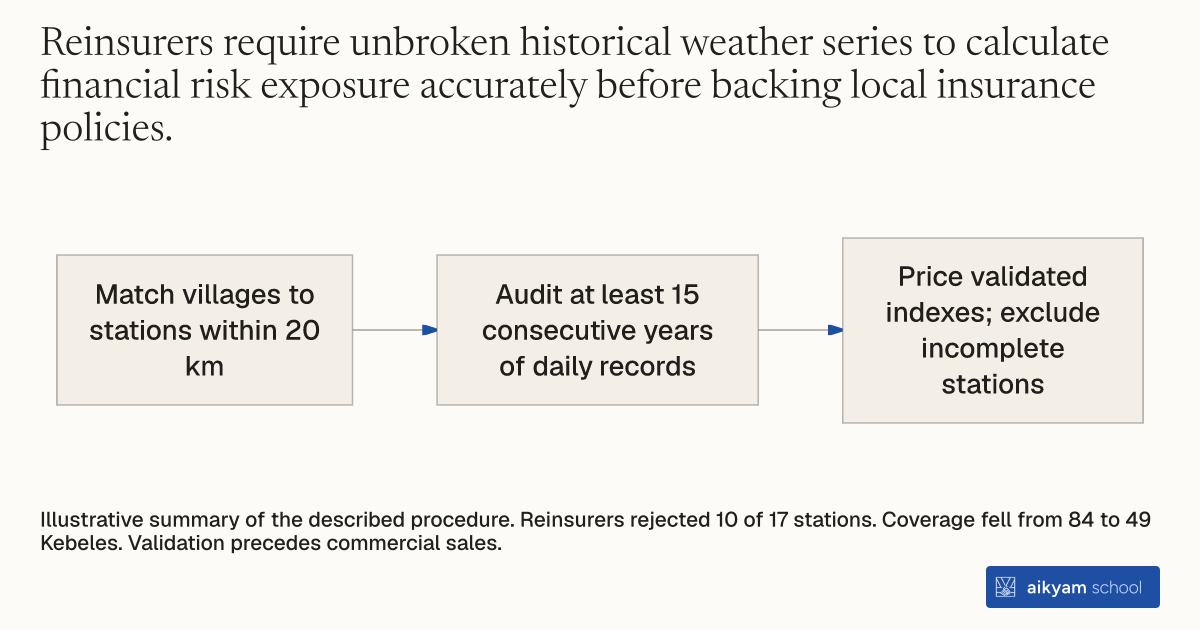
- Match villages to stations within 20 km
- Audit at least 15 consecutive years of daily records
- Price validated indexes; exclude incomplete stations
Illustrative summary of the described procedure. Reinsurers rejected 10 of 17 stations. Coverage fell from 84 to 49 Kebeles. Validation precedes commercial sales.
See source →How
When to use
Agricultural insurance providers need complete weather records to calculate drought probabilities before selling index policies to smallholders. International reinsurers reject index insurance contracts if local weather stations have missing historical records. Screen regional weather station data to identify insurable farming areas and satisfy reinsurance underwriting requirements.
Screen local weather station data to verify historical completeness before designing weather index contracts.
- Map target agricultural villages to the nearest regional weather monitoring station within a twenty-kilometer radius.
- Obtain daily historical rainfall records covering at least fifteen consecutive years from national meteorological services.
- Audit weather station logs to identify missing daily observations or gap-filled estimates.
- Calculate historical drought index distributions using complete weather station data series.
- Submit validated index calculations to international reinsurers for risk pricing and underwriting approval.
- Drop agricultural villages served by weather stations with incomplete historical records from commercial insurance sales.
Why it works
Screening out stations with incomplete records prevents contract cancellations and avoids issuing uninsurable policies.
Example
In Amhara, Ethiopia, project managers audited rainfall records across 17 weather stations serving 84 drought-prone Kebeles. Reinsurers rejected 10 weather stations because their historical rainfall logs were incomplete, forcing managers to drop 35 Kebeles and reduce the pilot sample to 49 Kebeles served by 7 reliable stations.
About the study
Participants
84 drought-vulnerable Kebeles across 4 zones in Amhara, Ethiopia served by 17 regional weather stations.
Study Design
Feasibility audit and data quality screening of historical daily rainfall records against reinsurer underwriting standards.
Results
Incomplete historical rainfall records at 10 out of 17 weather stations caused 35 out of 84 Kebeles (41.7%) to be excluded from index insurance coverage, reducing active coverage to 49 Kebeles.