In Simple Words
Picture a group of independent shopkeepers who organize weekly meetings or set up a shared online group chat to discuss business challenges. By sharing details about trusted wholesalers and referring overflow customers to one another, every shopkeeper in the network expands their client base and reduces operating costs.
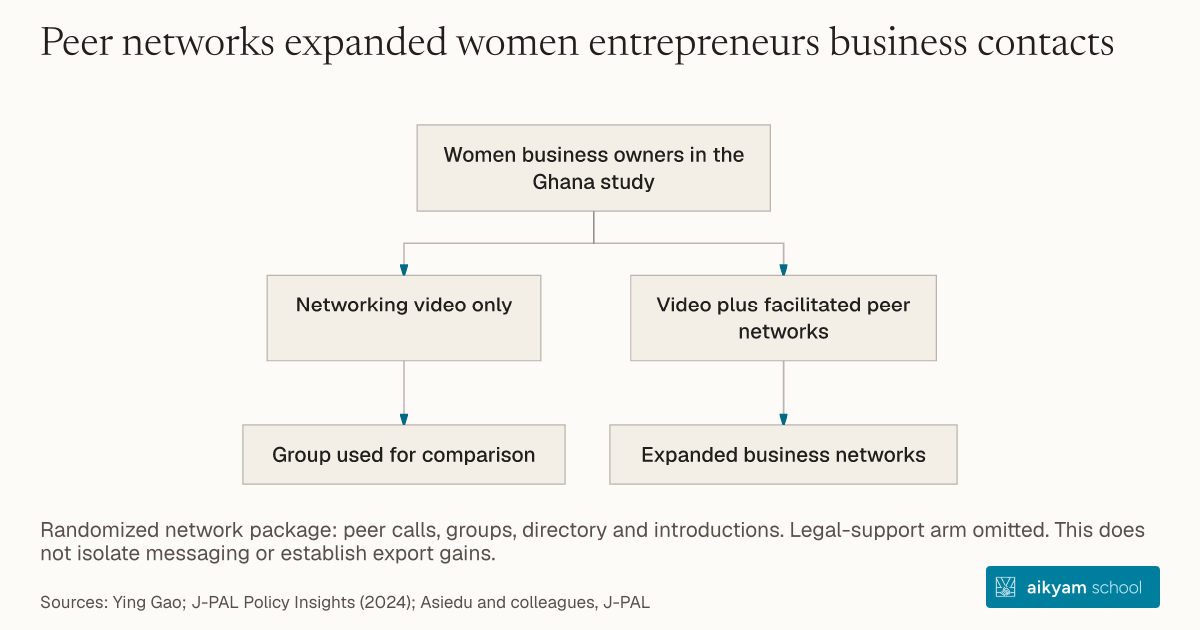
Women business owners in the Ghana study
- Networking video only
- Group used for comparison
- Video plus facilitated peer networks
- Expanded business networks
Randomized network package: peer calls, groups, directory and introductions. Legal-support arm omitted. This does not isolate messaging or establish export gains.
See source →Study conditions — Asiedu and colleagues, J-PAL ↗Research question
Entrepreneurs in low-income markets, particularly women business owners, often operate in isolation without access to broad business networks or professional contacts. This informational barrier limits their access to market opportunities, supplier recommendations, and peer learning.
Participants
Small and medium business owners, including female entrepreneurs, in Ghana and Tunisia.
Study Design
Randomized Controlled Trial (RCT) evaluating in-person business association meetings and low-cost digital messaging groups.
Results
Establishing structured peer networks enabled entrepreneurs to gain useful market contacts and business information, resulting in expanded professional networks and business collaborations, with pronounced benefits for female entrepreneurs who previously lacked contacts.
Takeaway
Establish structured peer networking groups and digital messaging networks for local business owners operating in the same geographic market to enable direct contact sharing and collaboration.
Source and citation
See source →Read alongside the research
Plain-English glossary
Original explanations, informed by the references below. Examples are illustrations, not data from the studies above. The research text stays unchanged.
- Randomized controlled trial
A study that uses chance, like drawing lots, to decide who receives each option being compared. Researchers compare the groups’ outcomes to estimate the effect of those options.
ExampleA lottery assigns volunteers to a training programme or a comparison group. Researchers then compare their outcomes.
GET-IT glossary · Randomized study ↗Read more about randomized controlled trial →