Research procedure
Cross-check clinic records at home
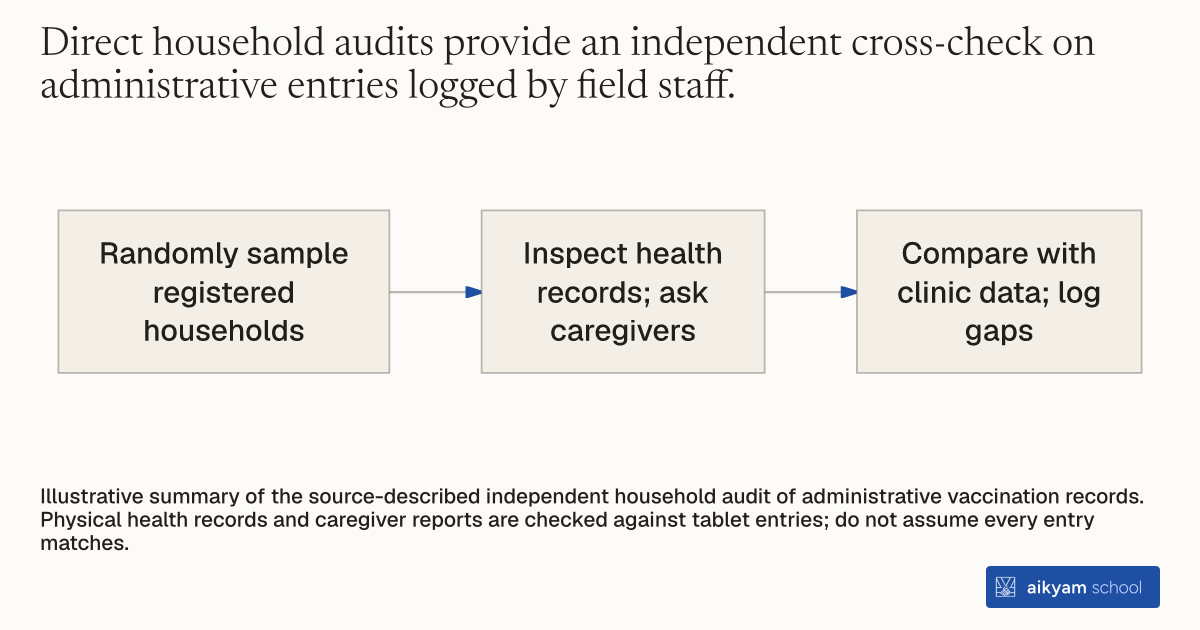
- Randomly sample registered households
- Inspect health records; ask caregivers
- Compare with clinic data; log gaps
Illustrative summary of the source-described independent household audit of administrative vaccination records. Physical health records and caregiver reports are checked against tablet entries; do not assume every entry matches.
See source →How
When to use
Development programs frequently rely on administrative records entered by frontline health workers. Administrative data can contain recording errors or missing records if staff fail to log visits accurately. Deploy this method to conduct independent household sample audits that verify administrative data quality.
Conduct independent household survey visits across a random sample of program participants to audit administrative records.
- Research managers select a random representative sample of households from clinic registration databases.
- Independent survey enumerators travel directly to selected target households across project villages.
- Enumerators inspect physical child health cards and interview caregivers about completed vaccination doses.
- Enumerators compare collected household responses against administrative records logged on health worker devices.
- Analysts assess discrepancy rates between survey reports and administrative logs to validate dataset accuracy.
Why it works
Grounding metrics in audited data prevents false reporting and ensures program decisions reflect true service delivery.
Example
In seven districts of Haryana, India, J-PAL researchers conducted independent household visits to audit administrative vaccination data recorded by nurses on tablet computers across 140 primary health centers.
About the study
Participants
Caregivers and infants sampled across 140 primary health centers and 755 subcenters in Haryana, India.
Study Design
Quality control data verification comparing frontline health worker tablet records against independent household survey audits.
Results
Verification visits confirmed that administrative records captured on tablet computers provided reliable data to evaluate immunization outcomes across 295,000 registered children.