Research procedure
Find nominees from a small village survey
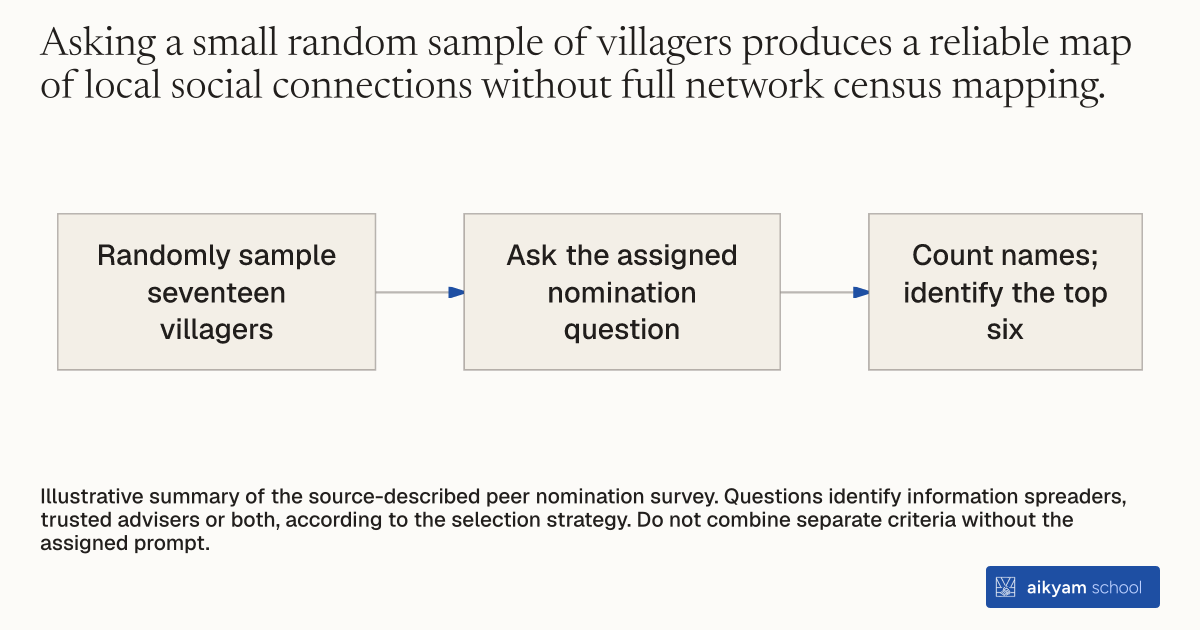
- Randomly sample seventeen villagers
- Ask the assigned nomination question
- Count names; identify the top six
Illustrative summary of the source-described peer nomination survey. Questions identify information spreaders, trusted advisers or both, according to the selection strategy. Do not combine separate criteria without the assigned prompt.
See source →How
When to use
Public health programs often struggle to identify key influencers who can effectively spread information across rural communities. Standard administrative lists or village leader appointments do not systematically locate natural network hubs. Deploy this method to conduct brief peer nomination surveys across a small sample of village residents.
Survey a small sample of randomly selected community members to identify peer nominees with specific social network traits.
- Survey enumerators select seventeen random individuals per village across target rural communities.
- Enumerators interview each selected respondent using a standardized social network prompt.
- Enumerators ask respondents to name individuals who meet specific criteria, such as being good at relaying information or trusted for advice.
- Program staff aggregate all peer nomination responses collected across the survey sample in each village.
- Program coordinators count nomination frequencies to identify the six most nominated individuals per village for program recruitment.
Why it works
This enables programs to identify central information hubs and trusted individuals rapidly and inexpensively.
Example
In 912 villages across seven districts of Haryana, India, researchers surveyed seventeen randomly chosen villagers per community to nominate local peers for health ambassador roles.
About the study
Participants
Seventeen randomly selected respondents per village across 912 villages in Haryana, India.
Study Design
A randomized controlled trial testing social network mapping via random sample peer nomination surveys to identify community ambassadors across 75 policy bundles.
Results
Surveying seventeen random villagers successfully identified information hubs whose outreach increased full child immunization by 26 percent relative to the comparison group.