Research procedure
Track the final scheduled dose
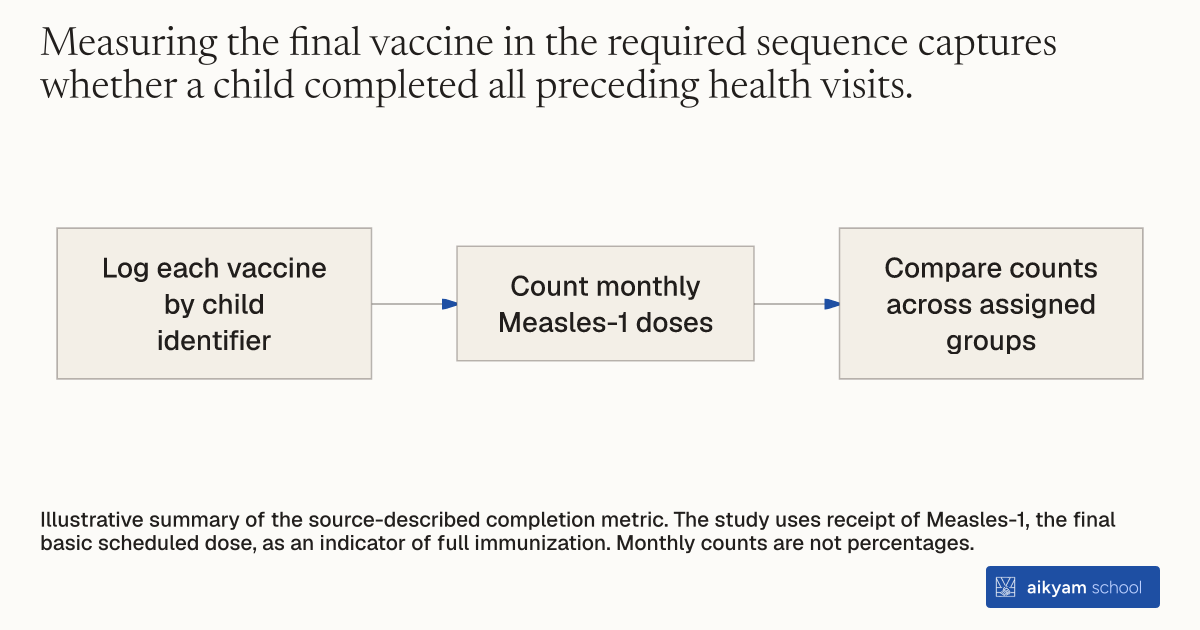
- Log each vaccine by child identifier
- Count monthly Measles-1 doses
- Compare counts across assigned groups
Illustrative summary of the source-described completion metric. The study uses receipt of Measles-1, the final basic scheduled dose, as an indicator of full immunization. Monthly counts are not percentages.
See source →How
When to use
Public health programs often struggle to assess full immunization compliance when tracking multiple vaccine doses across infant development. Collecting data on every dose can be resource-intensive, while early-dose counts mask subsequent dropout. Deploy this method to track receipt of the final schedule dose as a primary milestone indicator for full child immunization.
Use receipt of the final scheduled vaccine as a proxy metric to measure full child immunization completion rates across target communities.
- Clinic software developers establish receipt of Measles-1, the fifth and final basic dose, as the target completion metric.
- Auxiliary nurse midwives administer basic infant immunizations (BCG, Penta-1, Penta-2, Penta-3, and Measles-1) during monthly village sessions.
- Nurses log each delivered vaccine dose onto a mobile digital platform using each child's unique identification number.
- Program analysts calculate monthly village performance by counting the total Measles-1 doses delivered per session.
- Evaluators compare Measles-1 delivery rates across treatment and control arms to measure program impact on full immunization.
Why it works
It provides a clear, objective benchmark for full immunization without over-relying on self-reported parental memory.
Example
In 755 subcenters across Haryana, India, researchers used monthly Measles-1 deliveries per village to track full child immunization completion across 75 cross-randomized policy packages.
About the study
Participants
Caregivers and infants under twelve months of age across 140 primary health centers, 755 subcenters, and 912 villages in Haryana, India.
Study Design
A randomized controlled trial tracking administrative entries of the final scheduled dose (Measles-1) on tablet devices to measure full immunization completion.
Results
Tracking Measles-1 showed that the baseline full immunization rate was 7.32 completed schedules per village per month, which rose to 11.34 under the most effective policy package.