Research procedure
Survey household aspirations and attainment
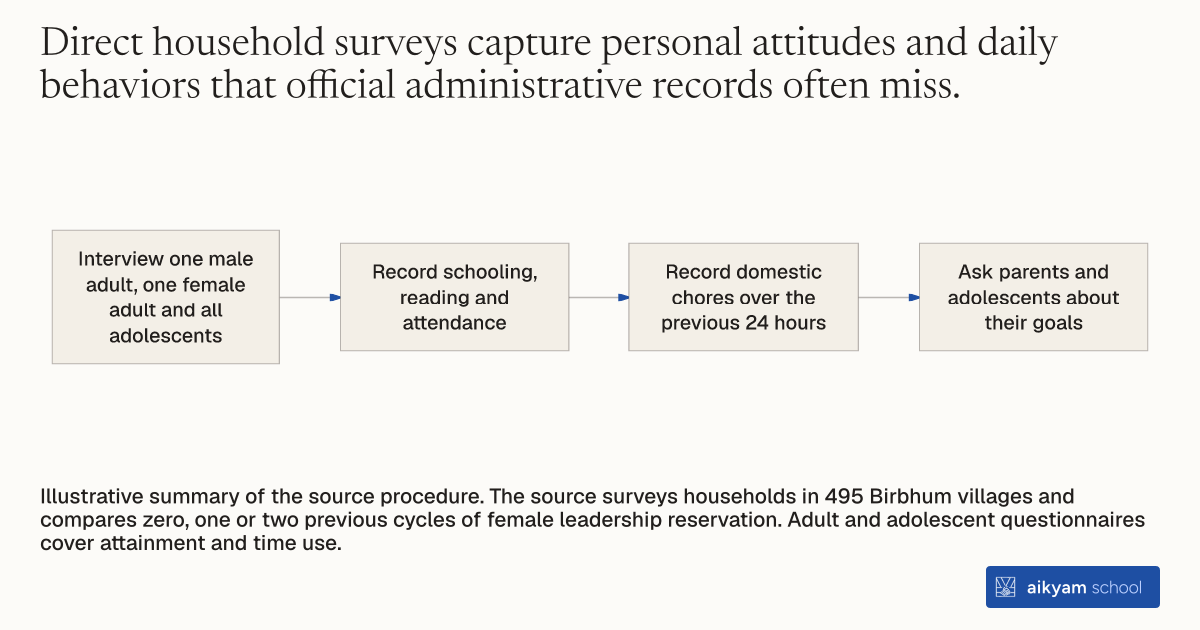
- Interview one male adult, one female adult and all adolescents
- Record schooling, reading and attendance
- Record domestic chores over the previous 24 hours
- Ask parents and adolescents about their goals
Illustrative summary of the source procedure. The source surveys households in 495 Birbhum villages and compares zero, one or two previous cycles of female leadership reservation. Adult and adolescent questionnaires cover attainment and time use.
See source →How
When to use
Development programs need to measure how political policies alter gender gaps in expectations and education across rural families. In many developing regions, parents hold lower educational aspirations for daughters than for sons, restricting girls' career opportunities. Researchers administer structured household surveys to compare parental goals and adolescent achievements across communities with different policy exposure.
Administer structured questionnaires to parents and adolescents across surveyed rural communities to measure educational goals and daily time allocation.
- Surveyors select sampled households in rural village councils in Birbhum district, West Bengal.
- Enumerators administer an individual questionnaire to one male adult and one female adult in each household.
- Interviewers survey all adolescent children residing within each sampled household.
- Surveyors record educational attainment, reading ability, and school attendance for each adolescent.
- Enumerators log daily time allocation across domestic chores over the previous 24 hours.
- Interviewers ask parents about educational goals for their children and adolescents about career goals for themselves.
Why it works
Asking both parents and adolescents reveals how role models in governance influence household investments and career goals.
Example
In Birbhum district, West Bengal, researchers surveyed households in 495 villages to evaluate how female political quotas affected aspirations and schooling. In twice-reserved villages, the gender gap in educational attainment disappeared, and adolescent girls spent 18 fewer minutes per day on domestic chores.
About the study
Participants
Surveyed households across 495 randomly selected rural villages in Birbhum district, West Bengal, India, interviewing one male adult, one female adult, and all resident adolescents.
Study Design
Cross-sectional survey comparing household attitudes, educational attainment, and time use across villages with zero, one, or two previous election cycles reserved for female leaders.
Results
In twice-reserved villages, the gender gap in educational attainment was completely erased, adolescent girls were 19 percentage points more likely to want to marry after age 18, and girls were 8.6 percentage points more likely to want a job that requires an education.