Research groups
Compare SMS extension with no SMS
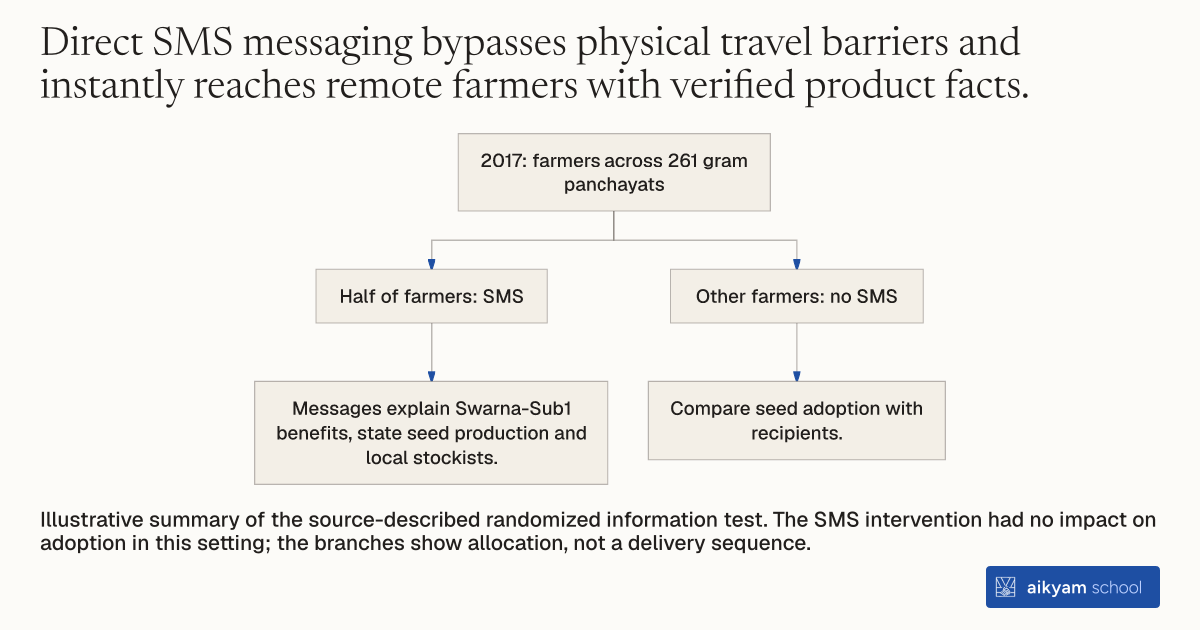
2017: farmers across 261 gram panchayats
- Half of farmers: SMS
- Messages explain Swarna-Sub1 benefits, state seed production and local stockists.
- Other farmers: no SMS
- Compare seed adoption with recipients.
Illustrative summary of the source-described randomized information test. The SMS intervention had no impact on adoption in this setting; the branches show allocation, not a delivery sequence.
See source →How
When to use
Smallholder farmers in flood-prone areas often lack information about improved stress-tolerant seed varieties and where to buy them. Traditional in-person extension services are expensive to scale across remote agricultural communities. Sending automated SMS text messages directly to farmers provides a low-cost digital channel to deliver advice on variety benefits, seed production source, and local retail availability.
Deliver automated mobile phone text messages to smallholder farmers to communicate crop technology benefits and purchase locations.
- Select target rural administrative units such as gram panchayats containing multiple villages.
- Collect mobile phone numbers from smallholder farmers across target communities.
- Write concise text messages explaining the specific submergence tolerance of Swarna-Sub1 flood-tolerant rice.
- Include state seed corporation details in each message to confirm seed certification.
- Name nearby commercial input suppliers in each message where farmers can purchase seeds.
- Send automated SMS messages directly to farmer mobile phones during the agricultural season.
Why it works
Informing farmers that local suppliers stock certified state-produced seeds lowers search costs and encourages direct store visits.
Example
Researchers in 2017 randomly assigned half of farmers across 261 gram panchayats in Odisha, India to receive SMS messages on Swarna-Sub1 rice use, state seed corporation availability, and local dealer stock. The SMS intervention produced no impact on farmer adoption relative to the comparison group.
About the study
Participants
Farmers across 261 gram panchayats (administrative units of about eight villages each) in coastal Odisha, India.
Study Design
Randomized controlled trial conducted in 2017 assigning half of farmers in 261 gram panchayats to receive SMS text messages on Swarna-Sub1 benefits, state seed corporation production, and local dealer purchasing locations, evaluated against non-received control groups.
Results
The SMS intervention had no impact on farmer adoption of technologies, generating a 0 percentage point change in Swarna-Sub1 adoption compared to the baseline.