Research recruitment
Sample households from birth records
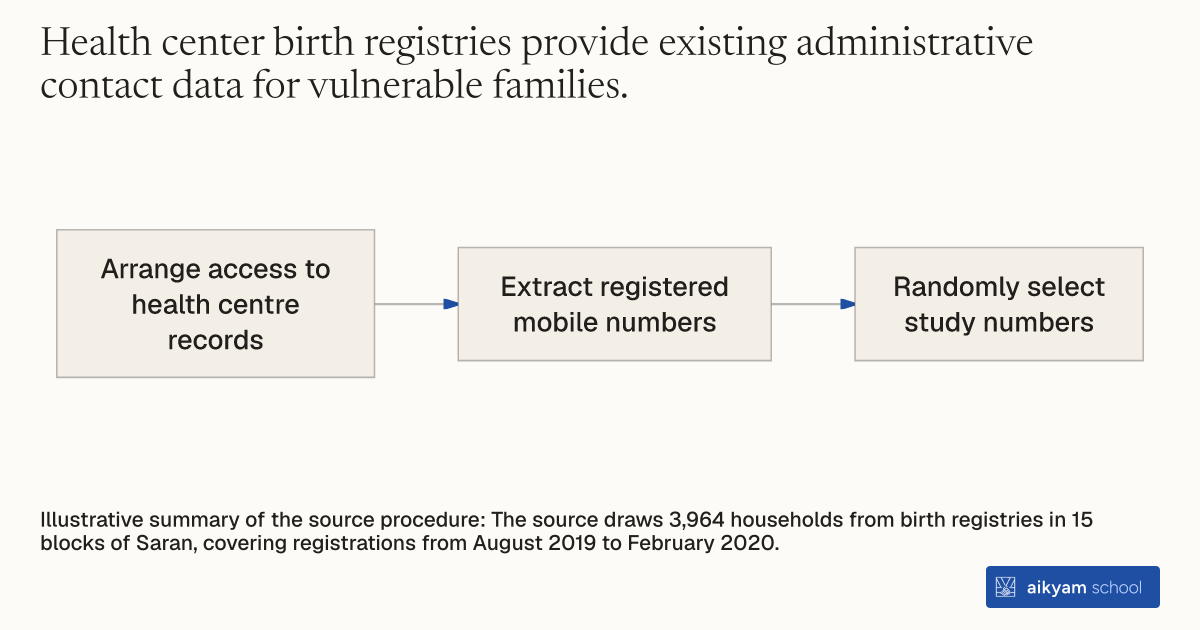
- Arrange access to health centre records
- Extract registered mobile numbers
- Randomly select study numbers
Illustrative summary of the source procedure: The source draws 3,964 households from birth registries in 15 blocks of Saran, covering registrations from August 2019 to February 2020.
See source →How
When to use
Public health programs during infectious disease outbreaks need efficient ways to reach local families with mobile communication. Existing administrative records like birth registries provide contact details without requiring costly new censuses. Program officers use this method to target households with young children for mobile health interventions.
Identify eligible target households by pulling registered mobile phone numbers from administrative birth records.
- Health officers partner with state health societies and health non-governmental organizations to obtain access to local health center records.
- Program administrators select primary health centers in targeted administrative blocks such as Saran in Bihar.
- Data clerks extract contact mobile numbers entered into birth registries over a specified time window from August 2019 to February 2020.
- Researchers randomly select target phone numbers from the compiled registry list to form treatment and comparison groups.
Why it works
This allows health organizations to rapidly deploy mobile phone communication without performing field enumeration.
Example
Researchers in Bihar, India partnered with the State Health Society and Suvita to recruit 3,964 households from birth registries across 15 blocks of Saran registered between August 2019 and February 2020.
About the study
Participants
3,964 households in 15 blocks of Saran, Bihar, India.
Study Design
Randomized controlled adaptive trial drawing mobile phone numbers from health center birth registries between August 2019 and February 2020 to test text message nudges over ten rounds.
Results
The study found no meaningful impact of SMS nudges on social distancing or handwashing behaviors across participants drawn from the birth registries.