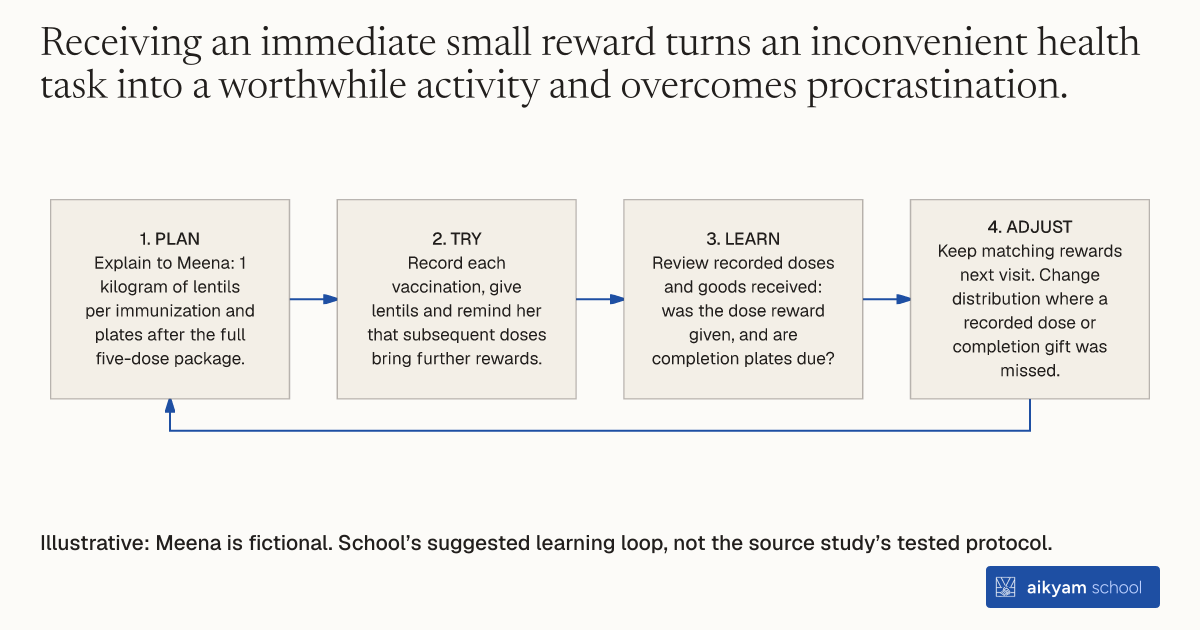
Try, learn and adjust
Check dose rewards and completion gifts
- Plan: Explain to Meena: 1 kilogram of lentils per immunization and plates after the full five-dose package.
- Try: Record each vaccination, give lentils and remind her that subsequent doses bring further rewards.
- Learn: Review recorded doses and goods received: was the dose reward given, and are completion plates due?
- Adjust: Keep matching rewards next visit. Change distribution where a recorded dose or completion gift was missed.
Illustrative: Meena is fictional. School’s suggested learning loop, not the source study’s tested protocol.
See source →School’s suggested, untested loop. Observe dose records, lentils and completion plates. The wider trial evaluates camps with incentives, not gifts alone.
How
When to use
Parents in rural areas often procrastinate taking children for repeated vaccine visits because medical benefits are delayed and visits are inconvenient. Although initial attendance may be high, parents drop out before completing the multi-dose vaccination series. Giving small in-kind rewards at each visit offsets minor hassles and motivates parents to finish the full package.
Provide small food and household items to parents every time they bring a child for an immunization shot.
- Medical staff offer a 1 kilogram bag of lentils to the parent for each immunization administered.
- Staff record the injection on the child's immunization tracking card.
- Social workers remind parents that returning for subsequent doses yields additional food rewards.
- Staff present a set of plates to the parent upon completion of the child's full five-dose immunization package.
Why it works
Small rewards provide a tangible present benefit for a preventive health action whose protection is delayed.
Example
Seva Mandir distributed a 1 kilogram bag of lentils per immunization and a set of plates for full completion across 30 villages in Udaipur, India. The incentives increased full immunization rates from 18 percent in camp-only villages to 39 percent, while halving the total cost per fully immunized child from US \$55.83 to US \$27.94.
About the study
Participants
134 rural villages in Udaipur, India, involving children aged 1 to 3 years.
Study Design
Clustered randomized controlled evaluation comparing 30 villages with camps plus incentives against 30 camp-only villages and 74 comparison villages.
Results
In-kind incentives increased full immunization rates sixfold from 6 percent in comparison villages to 39 percent, while reducing the cost per fully immunized child from Rs. 2,202 to Rs. 1,102.