Try, learn and adjust
Check monitoring reports lead to official action
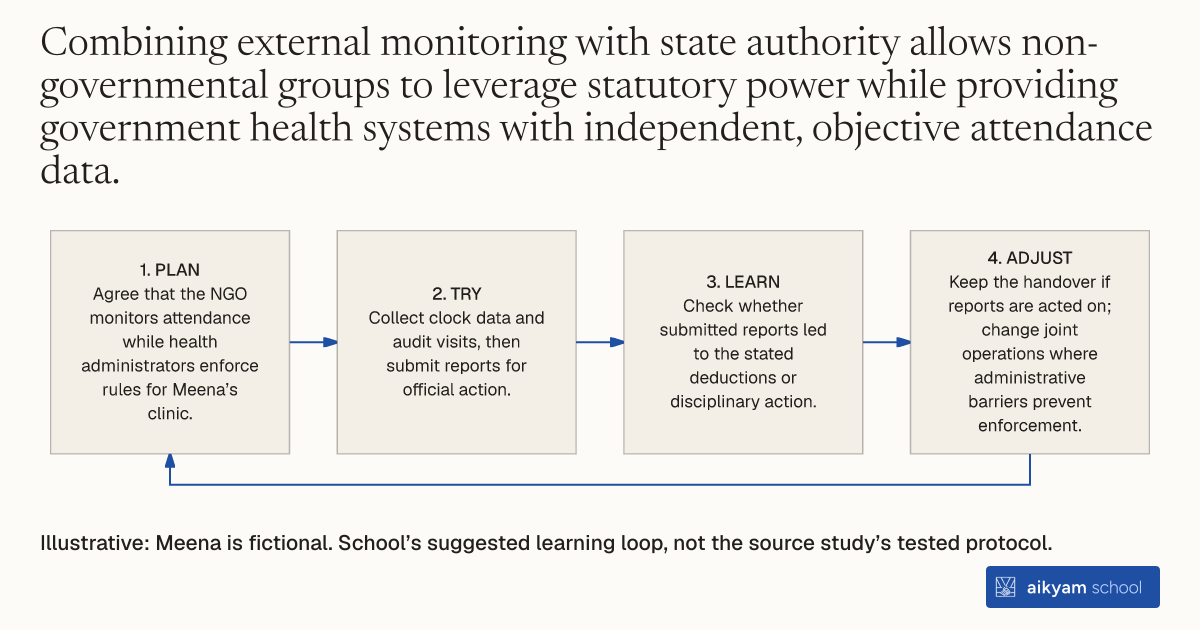
- Plan: Agree that the NGO monitors attendance while health administrators enforce rules for Meena’s clinic.
- Try: Collect clock data and audit visits, then submit reports for official action.
- Learn: Check whether submitted reports led to the stated deductions or disciplinary action.
- Adjust: Keep the handover if reports are acted on; change joint operations where administrative barriers prevent enforcement.
Illustrative: Meena is fictional. School’s suggested learning loop, not the source study’s tested protocol.
See source →Observe reports and enforcement. The example’s attendance gains faded as administration undermined implementation. School suggests this learning loop; it was not tested by the source.
How
When to use
Public health authorities in low-income settings struggle with chronic worker absenteeism and administrative inertia. Non-governmental organisations possess monitoring capacity but lack statutory authority to adjust public sector salaries. Form a joint initiative where a civil society group conducts independent monitoring while government officials enforce rules and financial consequences.
Partner non-governmental organisations with public health administrations to combine independent field monitoring with official regulatory enforcement.
- Establish a collaborative agreement between a civil society organisation and public health administrators.
- Direct the non-governmental organisation to manage monitoring equipment and audit worker attendance at rural clinics.
- Transmit independent worker attendance data from the non-governmental organisation to public health administrators.
- Require public health administrators to apply statutory salary deductions and disciplinary actions based on submitted reports.
- Review joint operations regularly to address administrative barriers and maintain program enforcement.
Example
NGO Seva Mandir partnered with state and district health administrations in Udaipur, India, to improve nurse attendance across subcenters serving 135 villages. Seva Mandir collected time clock data and conducted audits, while the district health administration applied official salary deductions and service suspensions.
About the study
Participants
Assistant Nurse Midwives at 100 rural public health centers serving 135 villages in Udaipur District, Rajasthan, India.
Study Design
Randomized controlled trial evaluating a joint NGO-government incentive program using tamper-proof time clocks and financial sanctions compared to standard government subcenters.
Results
Monitored nurse attendance initially increased by 15 percentage points in two-nurse centers and 29 percentage points in single-nurse centers on Mondays, but effects faded after six to fourteen months due to administrative undermining.