Research procedure
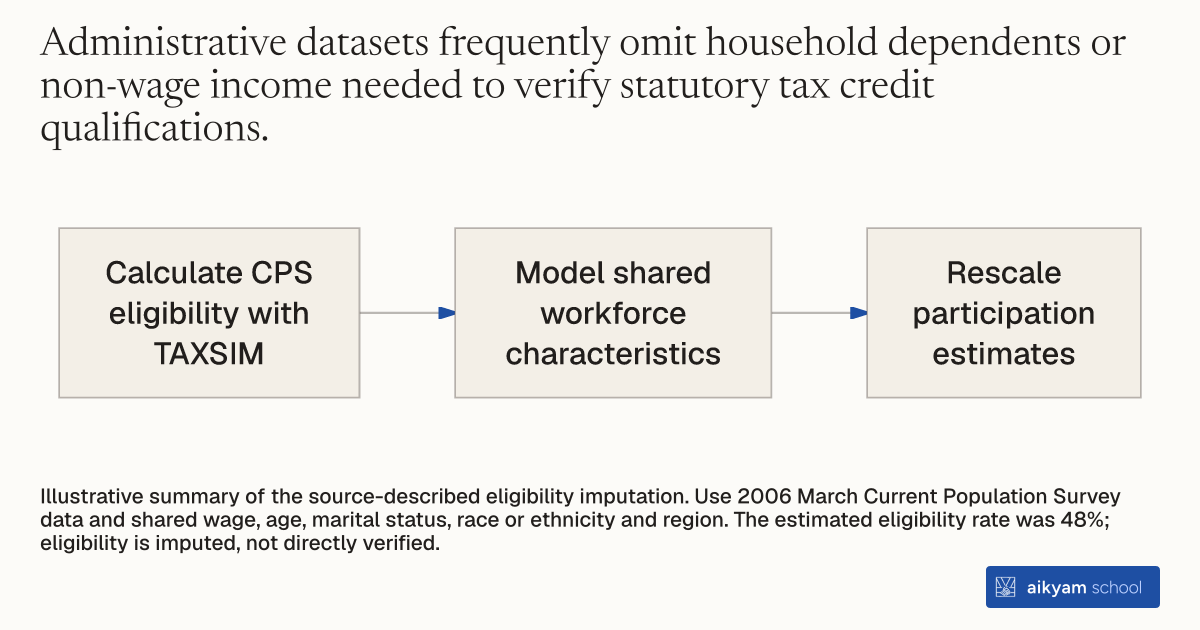
Estimate eligibility from survey data
- Calculate CPS eligibility with TAXSIM
- Model shared workforce characteristics
- Rescale participation estimates
Illustrative summary of the source-described eligibility imputation. Use 2006 March Current Population Survey data and shared wage, age, marital status, race or ethnicity and region. The estimated eligibility rate was 48%; eligibility is imputed, not directly verified.
See source →How
When to use
Administrative payroll records often lack household composition details needed to determine tax credit eligibility. Imputing program eligibility using external survey microdata and tax simulation models allows analysts to estimate participation rates among eligible workers. Researchers use this approach when evaluating benefit take-up without direct household tax return data.
Impute benefit eligibility by matching baseline administrative workforce demographics to external household survey data processed through a tax calculation algorithm.
- Extract hourly worker microdata from the March Supplement of the Current Population Survey.
- Calculate household EITC eligibility for survey respondents using the National Bureau of Economic Research TAXSIM model.
- Select demographic variables that overlap across survey and administrative datasets, including wage, age, marital status, race or ethnicity, and region.
- Estimate an imputation model using overlapping demographic variables to predict eligibility rates in administrative data.
- Apply predicted eligibility rates to rescale raw intent-to-treat participation estimates for eligible sub-populations.
Why it works
Matching administrative demographics to nationally representative survey microdata generates an empirical scaling factor to estimate true program participation among eligible workers.
Example
A study evaluating Advance EITC take-up among 7,277 hourly retail workers used 2006 March CPS microdata and NBER TAXSIM to estimate an employee eligibility rate of 48 percent, rescaling treatment participation increases from 0.5 and 0.8 percentage points up to 1.0 and 1.6 percentage points.
About the study
Participants
The imputation evaluated 7,277 hourly retail employees across 185 stores using wage, age, marital status, race/ethnicity, and region matched against the 2006 March Supplement of the CPS.
Study Design
NBER TAXSIM calculated eligibility for CPS tax units, and an empirical matching model based on overlapping demographic variables imputed eligibility rates for the administrative panel.
Results
The method generated an estimated EITC eligibility rate of 48 percent during the post-treatment week, rescaling treatment participation estimates from 0.5 and 0.8 percentage points up to 1.0 and 1.6 percentage points among eligible employees.