Research procedure
Link applications to official records
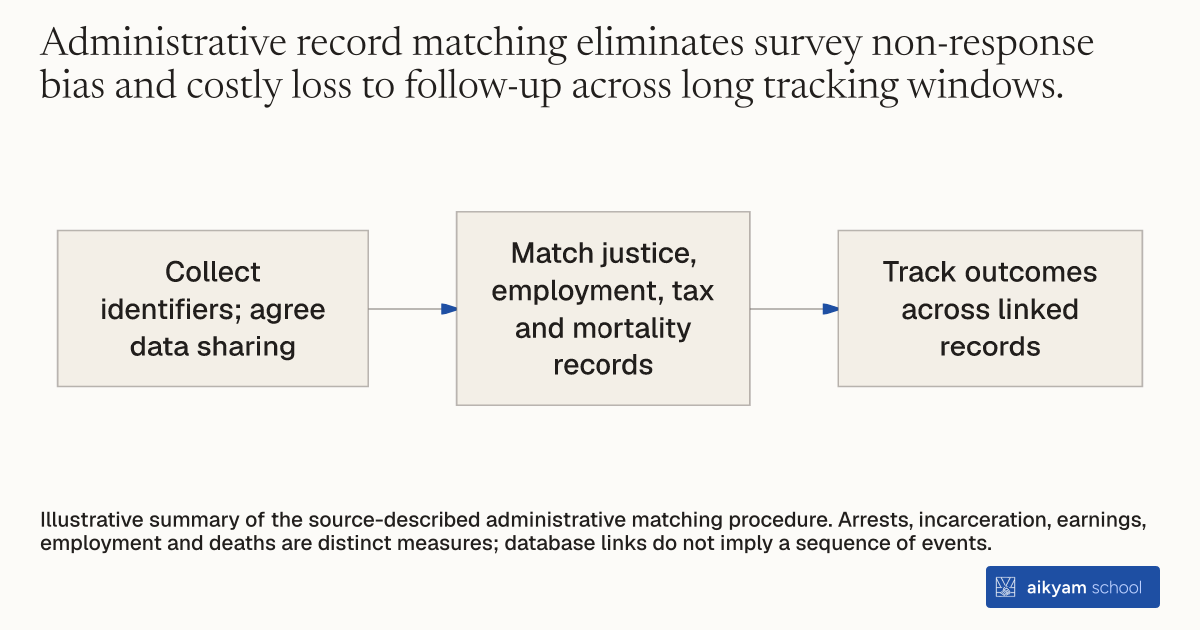
- Collect identifiers; agree data sharing
- Match justice, employment, tax and mortality records
- Track outcomes across linked records
Illustrative summary of the source-described administrative matching procedure. Arrests, incarceration, earnings, employment and deaths are distinct measures; database links do not imply a sequence of events.
See source →How
When to use
Evaluating youth interventions using self-reported survey data often suffers from high attrition, non-response, and social desirability bias. Program evaluators need objective, cost-effective methods to track long-term behavior, criminal justice contact, and employment among program participants. Linking program application data directly to multi-agency administrative records provides accurate, population-level outcome tracking over extended time horizons.
Evaluate social program impacts by matching participant application records with multi-agency administrative state and municipal databases.
- Collect participant identifiers, including social security numbers, full names, and dates of birth, during program application.
- Formulate data-sharing agreements between program administrators and government record custodians.
- Link program participant records to local police arrest databases to track violent and property crime charges.
- Match records with state department of corrections databases to identify incarcerations and prison time served.
- Connect participant identifiers to state employment security and IRS tax records to measure formal earnings and employment rates.
- Cross-reference participant records with municipal health department vital statistics registries to measure mortality and cause of death.
Why it works
Utilizing official agency records provides complete, objective longitudinal measurement of critical behavioral and economic outcomes.
Example
In New York City and Chicago, researchers linked program application lotteries for over 30,000 SYEP participants and 5,216 OSC+ applicants to police arrest logs, state corrections files, IRS tax data, and mortality registries to evaluate long-term impacts without relying on participant surveys.
About the study
Participants
Over 30,000 youth per year ages 14–21 in New York City (2005–2008 cohorts) and 5,216 male youth ages 16–22 in Chicago (2012–2013 cohorts; over 90% receiving free/reduced lunch).
Study Design
Randomized Controlled Trial (RCT) matching randomized lottery records across municipal police department arrest files, state corrections records, IRS tax databases, and municipal health vital statistics.
Results
Record matching revealed that NYC SYEP participation reduced 10-year prison incarceration by 0.10 percentage points (a 10 percent reduction) and reduced mortality by 0.073 percentage points (an 18 percent reduction), while Chicago OSC+ participation reduced 1-year violent crime arrests by 6.4 per 100 youth (a 35 percent reduction).