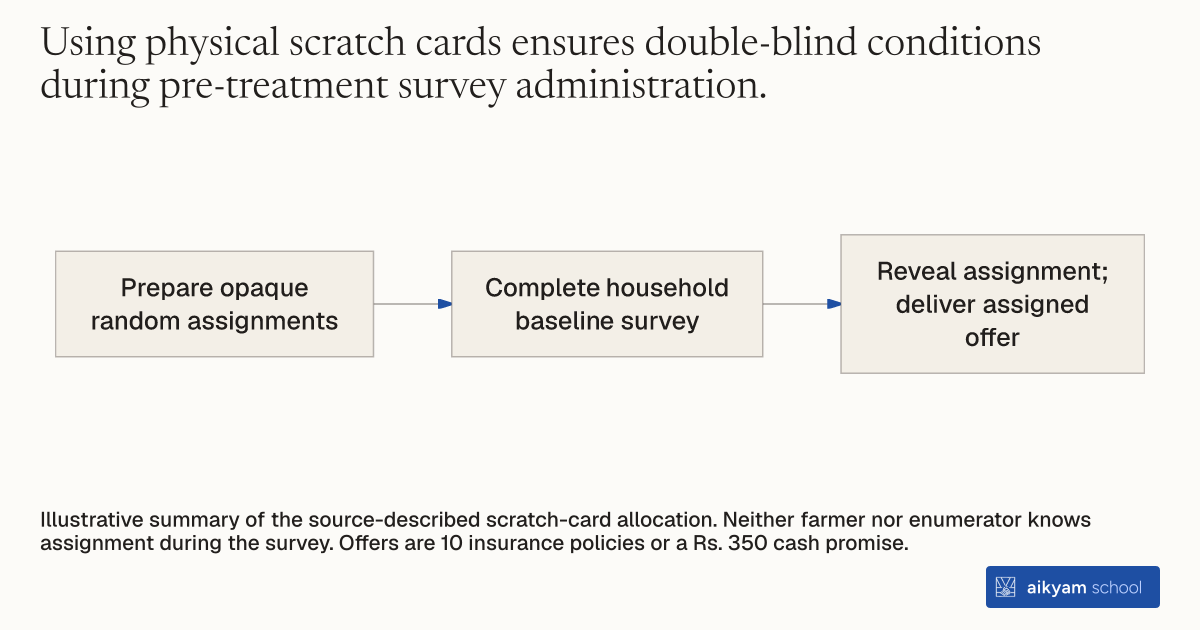
Research procedure
Reveal assignment after the baseline survey
- Prepare opaque random assignments
- Complete household baseline survey
- Reveal assignment; deliver assigned offer
Illustrative summary of the source-described scratch-card allocation. Neither farmer nor enumerator knows assignment during the survey. Offers are 10 insurance policies or a Rs. 350 cash promise.
See source →How
When to use
An evaluation team needs to assign treatment and control statuses to subjects during household visits without introducing surveyor bias or expectations. Unblinded enumerators or respondents can alter survey answers or marketing pitches if they know treatment conditions beforehand. Field staff distribute physical scratch cards to households so that treatment assignment is revealed only after baseline survey data collection is complete.
Assign households to treatment or control groups using pre-randomized opaque scratch cards delivered during home visits.
- Produce physical scratch cards pre-printed with randomized treatment or control assignments covered by an opaque scratch-off surface.
- Send trained enumerators to conduct a short baseline survey with targeted household heads at their homes at the start of the monsoon season.
- Hand a scratch card to the household head immediately after completing the baseline survey.
- Have the household head scratch off the opaque surface to reveal whether they are assigned to the treatment group or the control group.
- Deliver the assigned experimental intervention or control payout promise corresponding to the revealed card outcome.
Why it works
Neither the respondent nor the enumerator knows the experimental assignment while baseline data is being collected, preventing enumerator selection bias and framing effects.
Example
ICRISAT enumerators visited 1,479 farming households across 45 villages in Mahbubnagar and Anantapur, Andhra Pradesh, India, in June 2009. After completing a short survey, enumerators handed each farmer a scratch card revealing assignment to either 10 ICICI Lombard rainfall insurance policies (treatment) or an expected cash payout promise of Rs. 350 (control). The scratch-card procedure successfully balanced baseline characteristics across groups, with a significant difference appearing for only one variable out of all demographic and asset measures.
About the study
Participants
1,479 smallholder farming households across 45 villages in Mahbubnagar and Anantapur, Andhra Pradesh, India; 54% unschooled, average landholding 5.37 acres.
Study Design
Double-blind Randomized Controlled Trial using scratch cards to allocate insurance policies versus cash-equivalent promises independently across households.
Results
Scratch-card randomization achieved statistical balance across treatment and control groups across demographic, asset, livestock, credit, and past investment variables, with robust p-values showing no significant differences except for non-traditional savings (p < 0.10).