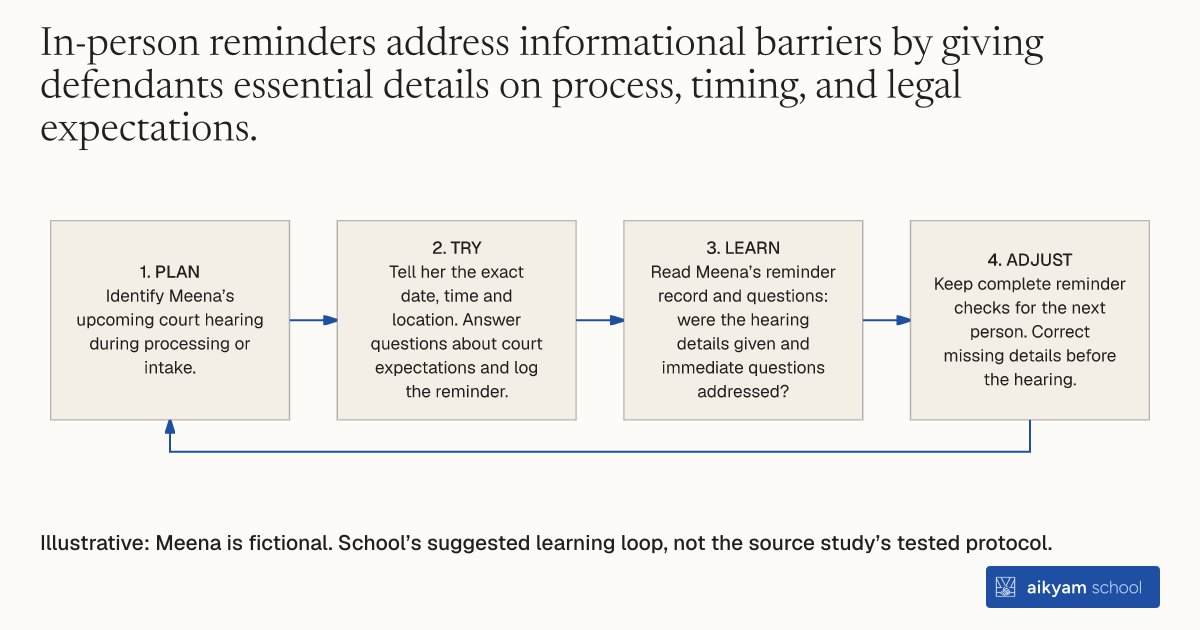
Try, learn and adjust
Check in-person hearing details and questions
- Plan: Identify Meena’s upcoming court hearing during processing or intake.
- Try: Tell her the exact date, time and location. Answer questions about court expectations and log the reminder.
- Learn: Read Meena’s reminder record and questions: were the hearing details given and immediate questions addressed?
- Adjust: Keep complete reminder checks for the next person. Correct missing details before the hearing.
Illustrative: Meena is fictional. School’s suggested learning loop, not the source study’s tested protocol.
See source →School’s suggested, untested loop. Observe hearing information, questions and reminder records; attendance is not assumed.
How
When to use
Many individuals facing scheduled court appearances fail to attend due to forgetfulness, confusion about procedures, or lack of clear information. Failing to appear leads to costly warrants, legal penalties, and disproportionate impacts on vulnerable populations. Delivering direct in-person court date reminders provides scheduled defendants with clear information to help them attend court.
Provide direct in-person reminders containing hearing details to individuals awaiting scheduled court appearances.
- Court or judicial staff identify individuals with upcoming scheduled court dates.
- Staff interact directly with defendants in person during court processing or intake.
- Personnel convey essential appearance details including the exact time, date, and location of the hearing.
- Staff answer immediate questions regarding court expectations and procedural requirements.
- Administrative personnel log the completed in-person reminder in the tracking system.
Why it works
Direct communication helps individuals anticipate their appearance and plan ahead to attend court.
Example
Across multiple US jurisdictions evaluated in a synthesis of nine randomized trials, program staff delivered in-person, phone, mail, or text reminders to individuals awaiting court processing, which consistently reduced failure to appear rates.
About the study
Participants
Individuals awaiting court processing and arraignment across multiple US jurisdictions in nine randomized evaluations.
Study Design
Randomized evaluations testing informational reminders delivered in person, via phone, mail, or text message against comparison groups receiving standard processing or no reminders.
Results
Providing information about court appearances through in-person reminders, phone calls, mail, or text messages led to a reduction in failure to appear rates across nine randomized evaluations.