Try, learn and adjust
Use replies to identify court-attendance barriers
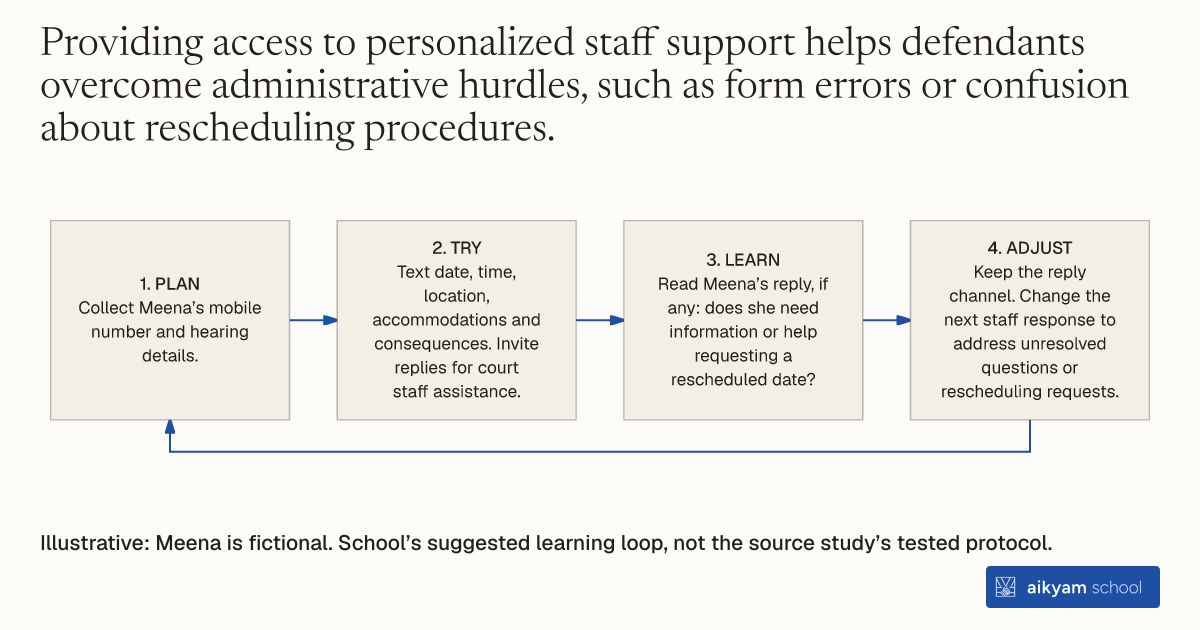
- Plan: Collect Meena’s mobile number and hearing details.
- Try: Text date, time, location, accommodations and consequences. Invite replies for court staff assistance.
- Learn: Read Meena’s reply, if any: does she need information or help requesting a rescheduled date?
- Adjust: Keep the reply channel. Change the next staff response to address unresolved questions or rescheduling requests.
Illustrative: Meena is fictional. School’s suggested learning loop, not the source study’s tested protocol.
See source →School’s suggested, untested loop. Observe incoming questions and staff assistance; a rescheduling request is not an approved new date.
How
When to use
Many individuals awaiting arraignment face external obligations or administrative burdens that make attending their original court date difficult. Missing court leads to severe penalties, including potential arrest warrants and jail time. Sending two-way interactive text message reminders with an offer of direct help from court staff enables defendants to reschedule their court dates when conflicts arise.
Send interactive text message reminders that invite individuals awaiting arraignment to reply directly with questions or requests for assistance from court staff.
- Court administrative staff obtain mobile phone numbers for individuals awaiting arraignment.
- Staff send text messages containing appearance dates, times, locations, court accommodations, and failure to appear consequences.
- The text message includes an explicit invitation for recipients to text back with questions for court personnel.
- Court staff monitor incoming text responses and assist individuals with questions or court date rescheduling requests.
Why it works
This direct assistance allows individuals to address scheduling conflicts and engage with the legal system rather than missing court entirely.
Example
In a large municipal county court system, sending text message reminders combined with an invitation to message court staff for assistance reduced failure to appear rates from 21.3 percent to approximately 13 percent by helping defendants reschedule their court dates.
About the study
Participants
Individuals awaiting court arraignment in a large municipal county court system.
Study Design
Randomized field experiment evaluating text reminders plus personalized court staff assistance against a comparison group receiving no text messages.
Results
Sending two-way text reminders with staff assistance reduced failure to appear rates by over 8 percentage points from 21.3 percent to approximately 13 percent, representing a 39 percent decrease, driven primarily by an increase in rescheduled court dates.